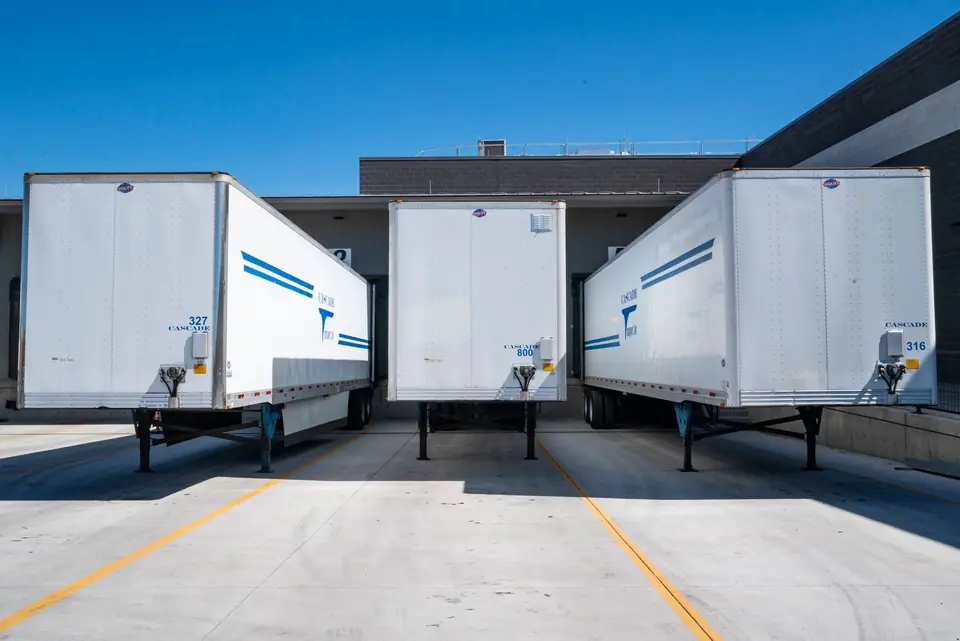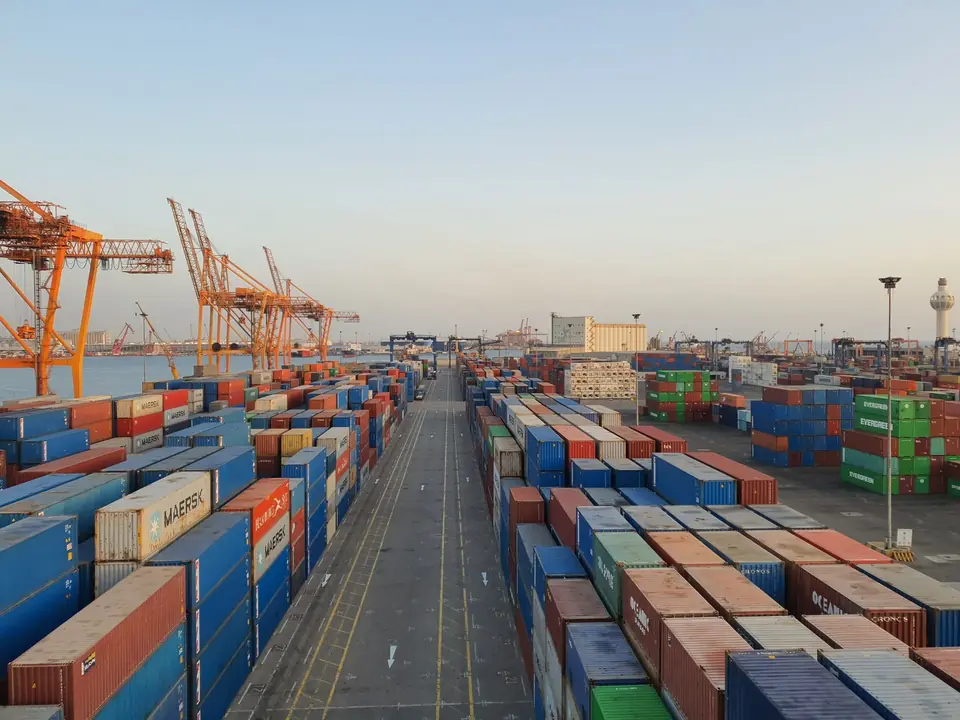
40-foot high cube against standard containers
ISO containers share the same 8-foot external width; length and height change. The high cube adds 12 inches of external height, from 8 feet 6 inches to 9 feet 6 inches, and nearly all of it shows up inside.
| Specification | 20' standard | 40' standard | 40' high cube |
|---|---|---|---|
| External (L × W × H) | 20' × 8' × 8'6" | 40' × 8' × 8'6" | 40' × 8' × 9'6" |
| Interior (L × W × H) | 19'4" × 7'8" × 7'10" | 39'5" × 7'8" × 7'10" | 39'5" × 7'8" × 8'10" |
| Door opening (W × H), approx. | 7'8" × 7'6" | 7'8" × 7'6" | 7'8" × 8'5" |
| Capacity | 1,172 cu ft · 33.2 CBM | 2,385 cu ft · 67.5 CBM | 2,694 cu ft · 76.3 CBM |
| Rated max payload | 47,900 lbs | 58,800 lbs | 58,450 lbs |
| 48×40 pallets, single tier | 10 | 20 | 20 |
Figures are typical; boxes vary slightly by manufacturer, and the data plate on the door governs rated weights. The high cube's door is about 101 inches tall against about 90 for a standard box, which matters as much as the interior: a 94-inch crate fits inside a standard 40 on paper but will not go through its door.
The gain is 2,694 − 2,385 = 309 cu ft, about 13% more cube for the same floor. For freight that cubes out, that can be the difference between three standard boxes and two high cubes plus change.
Pallets in a 40-foot high cube
The container is about 92 inches wide inside, roughly 6 inches narrower than a 53-foot van. That rules out the van's turned pattern and changes the counts:
| Pallet | Pattern | Positions | Why |
|---|---|---|---|
| 48×40 GMA | Straight (48" along) | 18 | 2 × 40" = 80" across; 9 rows of 48" = 432" of 473" |
| 48×40 GMA | Pinwheel | 20 | 48 + 40 = 88" across; 10 paired rows at 44" average = 440" |
| 48×40 GMA | Turned (40" along) | 11 | Two 48" sides need 96"; only one fits across |
| 48×48 | Any | 9 | Only one across; 9 rows of 48" |
| 1200×800 Euro | Pinwheel / mixed | ~24 | Narrow footprint packs well across 92" |
Pinwheel is the standard for GMA pallets in containers, and 20 is the planning number; you will sometimes see 21 quoted, which depends on the exact interior length and how much overhang the pallets carry. The real advantage of the high cube for palletized freight is vertical: tall pallets up to about 100 inches through the door, or two tiers of 48-inch pallets with 10 inches to spare.
Floor loading cartons: where the extra foot pays
Much import freight is floor-loaded: cartons stacked directly on the container floor to use every inch. Take a carton of 24 × 18 × 18 inches (4.5 cu ft) and a usable interior of 473 × 92 × 106 inches.
- Standard 40, 94 inches tall. Standing the cartons 18 inches tall gives 5 layers (90 inches); 24 inches along the length gives 19 rows (456 inches) and 18 inches across gives 5 (90 inches). That is 19 × 5 × 5 = 475 cartons. Standing them 24 inches tall only gets 3 layers, 390 cartons.
- High cube, 106 inches tall. Standing the cartons 24 inches tall gives 4 layers (96 inches) on an 18 × 18 footprint: 26 rows (468 inches) × 5 across × 4 = 520 cartons.
- Result. 520 against 475, 45 more cartons or 9.5% more product per box. 520 × 4.5 = 2,340 cu ft, 87% of the nominal 2,694.
Floor loading is slow to unload, often several hours for a full box by hand, so many importers palletize at origin and accept fewer units per container in exchange for a fast forklift unload. The trade-off is worth running both ways: 45 extra cartons per box against the labour and detention time at the destination dock.
The 87% figure is typical of a well-planned floor load. Pallet loads use less, because the pallet deck and the gaps around footprints are dead space; a 20-pallet load of 90-inch pallets fills about 74%.
Check your container load
- Safe — tariff cube, density and linear feet stay under the carrier's cube and linear-foot rules.
- Tier 1 — 350 cu ft or more under 3 PCF (XPO, Saia, ABF, Estes): synthetic weight of 6 lbs per tariff cubic foot.
- Re-bill — 750 cu ft or more under 6 PCF, or linear feet at the carrier's rule: book volume LTL or direct partial truckload.
Worked example: twenty tall pallets, transloaded inland
Twenty pallets of upholstered furniture, 48×40×90 inches, 900 lbs each, non-stackable, arriving at a West Coast port for a 600-mile inland move. This is the engine preset on this page.
- Cube. 48 × 40 × 90 = 172,800 ÷ 1,728 = 100 cu ft × 20 = 2,000 cu ft, 74% of 2,694.
- Weight and density. 20 × 900 = 18,000 lbs ÷ 2,000 = 9.0 PCF, Class 100.
- Box choice. At 90 inches the pallets need the high cube's door; a standard 40's door at about 90 inches gives no clearance for the forks.
- Floor. Twenty positions pinwheeled: the container is full by floor.
- Inland. Transloaded into a 53-foot van, the 20 pallets take 10 straight rows, 40 linear feet of 52.5. Indicative truckload cost for 600 miles is about $1,470 in our model.
Transloading is common for exactly this reason: the van carries more than the container. Three 40-foot high cubes hold 3 × 20 = 60 pallet positions; two 53-foot vans loaded turned hold 2 × 30 = 60. By cube, 3 × 2,694 = 8,082 cu ft against 2 × 3,950 = 7,900, close enough that three containers of anything short of full cube commonly go into two vans. See the Southern California corridor for port transload lanes.
Road weight limits on a loaded container
A 40-foot high cube is rated for about 58,450 lbs of cargo, but a container on a North American road is limited by the truck, not the box. Federal limits allow 80,000 lbs gross and 34,000 lbs per tandem. Take a tractor around 17,000 to 19,000 lbs, a chassis around 5,000 to 7,000 lbs and a high cube tare of roughly 8,700 to 8,800 lbs, and about 44,000 lbs of cargo remains on a standard tandem chassis. Tri-axle chassis and overweight permits in port areas can raise that.
| Item | Approximate weight |
|---|---|
| Tractor | 17,000–19,000 lbs |
| Chassis (tandem) | 5,000–7,000 lbs |
| 40' high cube tare | 8,700–8,800 lbs |
| Federal gross limit | 80,000 lbs |
| Cargo left (typical) | ~44,000 lbs |
High-cube freight rarely gets near that: the 20-pallet furniture load weighs 18,000 lbs. Dense freight such as tile, stone or metal will weigh out the road limit long before filling the box, and is usually better in a standard 20 or 40.
Plan the container floor
Select the 40-foot high cube in the planner and set your pallet or crate size to compare straight and pinwheel counts.
Use the engine above for cube, density and how the same load sits in a 53-foot van after transload, and the CBM to cubic feet calculator when your packing list is in metric.
How Cubic Transport handles container freight inland
Cubic Transport brokers the domestic leg: drayage from the port or rail ramp, transload into 53-foot vans, and partial or truckload delivery to the consignee. We do not own chassis or trucks; we tender each leg to carriers that run it.
- Send the packing list. Piece count, dimensions and weights, in metric or imperial.
- Choose direct or transload. We compare a direct container move against transloading into vans, by cost and by delivery requirements.
- Plan the van loads. Pallet patterns and stackability for each van, or a partial if the last van is light.
- Tender and track. Each leg to a carrier on the lane, with appointments at the consignee.
Send container details to rates@cubictransport.com.