What "high cube" means on a 53-foot dry van
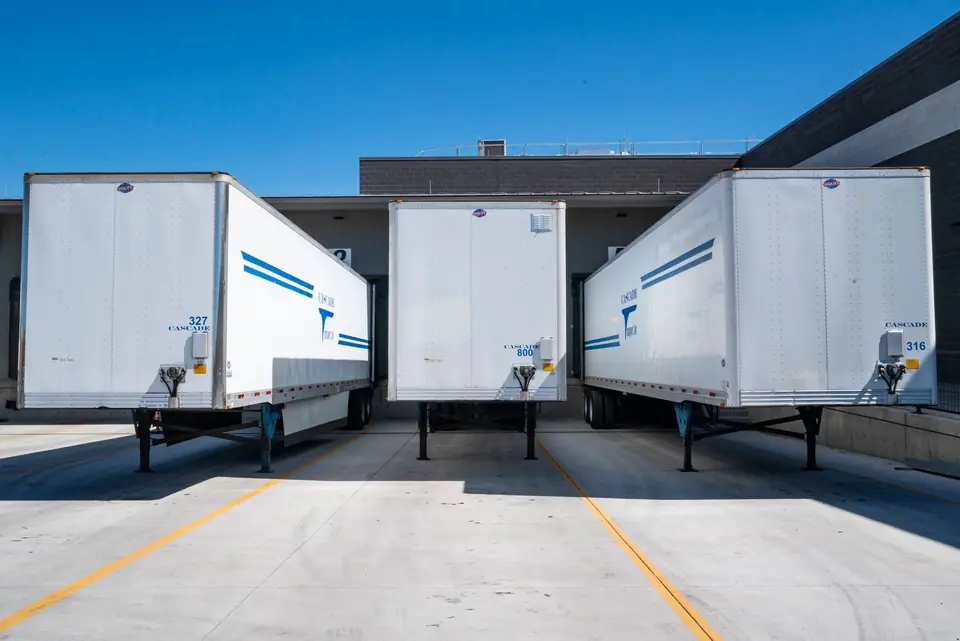
Almost every 53-foot dry van in North American truckload service is a high-cube trailer: a low-profile floor over the tandems and a roof at the 13-foot-6-inch legal height, giving about 110 inches inside instead of the 100 to 102 inches of older or lower vans. The extra height is what lets two tiers of 48-inch pallets, or one tier of tall fixtures and cabinets, ride without crushing anything.
For high-cube freight the trailer's interior is the product. Light commodities such as ductwork, foam, packaging, cabinetry and furniture fill the box long before they approach the weight limit, so a carrier's rate is effectively a price per cubic foot of trailer. Knowing exactly how much cube a given trailer offers, and how much of it your freight can use, is what decides whether a load fits on one truck or needs two.
Cubic Transport tenders truckloads to asset carriers on the lane; we do not own trailers. We size the load against the trailer type it needs, specify door and height requirements in the tender, and manage pickup and delivery appointments.
53-foot dry van interior dimensions
| Specification | Logistics-post van | Plate (composite-wall) van |
|---|---|---|
| Interior length | 52'6"–52'8" | 52'6"–52'8" |
| Interior width | ~98.5–99" | ~100–101" |
| Interior height | ~108–110" | ~108–110" |
| Rear door opening width | ~98" | ~99–100" |
| Rear door opening height | ~104–110" | ~104–110" |
| Cubic capacity | ~3,800–3,950 cu ft | ~3,950–4,054 cu ft |
| 48×40 floor positions | 26 straight, 30 turned | 26 straight, 30 turned |
| Typical payload | ~44,000–45,000 lbs | ~44,000–45,000 lbs |
These are working ranges; individual trailers vary with builder, floor and roof design. Our engine plans with 630 × 98.5 × 110 inches, which is 6,825,750 cubic inches ÷ 1,728 = 3,950 cu ft. A plate trailer at about 101 inches wide gains roughly 100 cubic feet over that, which is where figures above 4,000 come from.
Plate trailers versus logistics-post trailers
A logistics-post van has vertical posts along the side walls with slots for load bars, decking beams and straps. The posts and lining cost a little width, typically leaving 98.5 to 99 inches inside. A plate trailer uses thin composite side walls, often with horizontal logistic track built in, and keeps closer to 100 to 101 inches.
- Width matters for 48-inch-wide units. Two 48×48 pallets need 96 inches. In a 98.5-inch van that leaves 2.5 inches; in a 101-inch van, 5 inches. Overhang of even an inch per side can make the difference between two across and one across.
- Posts matter for securement. Logistics posts give many anchor points for load bars and decking beams, which help with partial loads, stacked freight and anything that can shift.
- Turned GMA pallets need width. The 30-pallet turned pattern puts two 48-inch sides across: 96 inches in a 98.5-inch van. It works with clean pallets and no overhang.
We specify the trailer type in the tender only when the load needs it. Most truckloads fit either.
Other options are worth naming only when the freight calls for them: air-ride suspension for electronics, lab equipment and finished furniture; a food-grade trailer, clean, dry and odour-free, for food and packaging that touches food; and load bars or decking beams for partial or stacked loads. Each narrows the pool of available trailers a little, so we ask for them when they protect the freight and not by default.
Cubing out versus weighing out
A truckload is limited by whichever runs out first: floor, cube or weight. Federal limits allow 80,000 lbs gross and 34,000 lbs on each tandem axle group. A typical tractor and 53-foot van weigh about 35,000 to 36,000 lbs together, which leaves roughly 44,000 to 45,000 lbs for cargo.
| Freight | Density | What runs out first | Weight at 3,950 cu ft |
|---|---|---|---|
| Foam, ductwork, empty containers | Under 4 PCF | Cube | Under 15,800 lbs |
| Cabinets, furniture, fixtures | 4–8 PCF | Cube or floor | 15,800–31,600 lbs |
| Boxed goods, electronics | 8–11 PCF | Either | 31,600–43,450 lbs |
| Beverages, tile, steel | Over 11.4 PCF | Weight | Over 45,000 lbs at full cube |
The break-even density is about 45,000 ÷ 3,950 = 11.4 PCF. Below it, you cube out and pay for air you cannot use; above it, you weigh out with floor and height to spare. High-cube freight sits well below the line, so the payoff is in using every inch of height: stacking where the freight allows, and choosing pallet heights that pair into two tiers.
Check a full trailer of skids
- Safe — tariff cube, density and linear feet stay under the carrier's cube and linear-foot rules.
- Tier 1 — 350 cu ft or more under 3 PCF (XPO, Saia, ABF, Estes): synthetic weight of 6 lbs per tariff cubic foot.
- Re-bill — 750 cu ft or more under 6 PCF, or linear feet at the carrier's rule: book volume LTL or direct partial truckload.
Worked example: 26 non-stackable skids, 1,200 miles
Twenty-six skids of upholstered seating, 48×40×80 inches, 700 lbs each, cannot take weight on top. This is the engine preset on this page.
- Cube. 48 × 40 × 80 = 153,600 ÷ 1,728 = 88.89 cu ft × 26 = 2,311.1 cu ft. That is 58.5% of a 3,950-cu-ft van: the floor is full but 30 inches of height above each skid is empty.
- Weight and density. 26 × 700 = 18,200 lbs ÷ 2,311.1 = 7.88 PCF, Class 125. Weight is about 41% of payload.
- Floor. Two across in 13 rows of 48 inches = 624 inches, 52 linear feet. The trailer is full by floor.
- In LTL terms. Imputed to 96 inches the load is 2,773.3 cu ft at 6.56 PCF, just above the 6-PCF cube tier, but 52 linear feet is more than four times the 12-foot linear rule. Rated as LTL it would be about $4,755 at class and $6,246 after a re-rate.
- Truckload. In our model a 53-foot dry van over 1,200 miles is about $2,940 all-in.
The lesson is the empty 30 inches. If the seating could be packed to 48 inches and made stackable, the same pieces in more units could ride two-high, and a second trailer on a recurring program might become one. Rates are indicative planning figures.
Drop-trailer programs
On a live load, the truck backs in, waits while you load, and leaves. On a drop-trailer program, the carrier leaves an empty trailer at your dock, you load it on your own schedule, and a driver swaps it for an empty when it is ready. Drop trailers suit shippers with steady outbound volume and limited dock labour, because they remove the clock: no driver waiting, no detention after the free time, which is commonly two hours on a live load.
- Volume. Carriers commit trailers to a pool where they get regular loads, typically several a week from the same dock.
- Yard space. You need somewhere to park the pool trailers and a way to move them, either the carrier's drivers or your own yard tractor.
- Seals and paperwork. You load, count and seal; the bill of lading notes "shipper load and count" with the seal number.
- Loading quality. With no driver watching, loading falls entirely on your team: load bars, weight distribution and nothing stacked on non-stackable freight.
We set up drop programs with carriers that run your outbound lanes and price them per load, with any pool or trailer-usage terms written into the rate.
How Cubic Transport tenders a truckload
- Size it. Piece count, dimensions, weight, stackability, and the tallest unit.
- Check fit. Floor positions and cube against a 53-foot van, and whether a partial at 30 to 34 feet would cost less.
- Specify equipment. Standard van, plate trailer, air-ride, food-grade or load bars, only when the freight needs it.
- Tender. To an asset carrier on the lane, with live-load or drop terms, appointments and any detention terms stated up front.
- Track to delivery. Dispatch follows the load through to a signed delivery receipt.
For pallet patterns see the 53-foot pallet configuration guide. Send loads to rates@cubictransport.com.