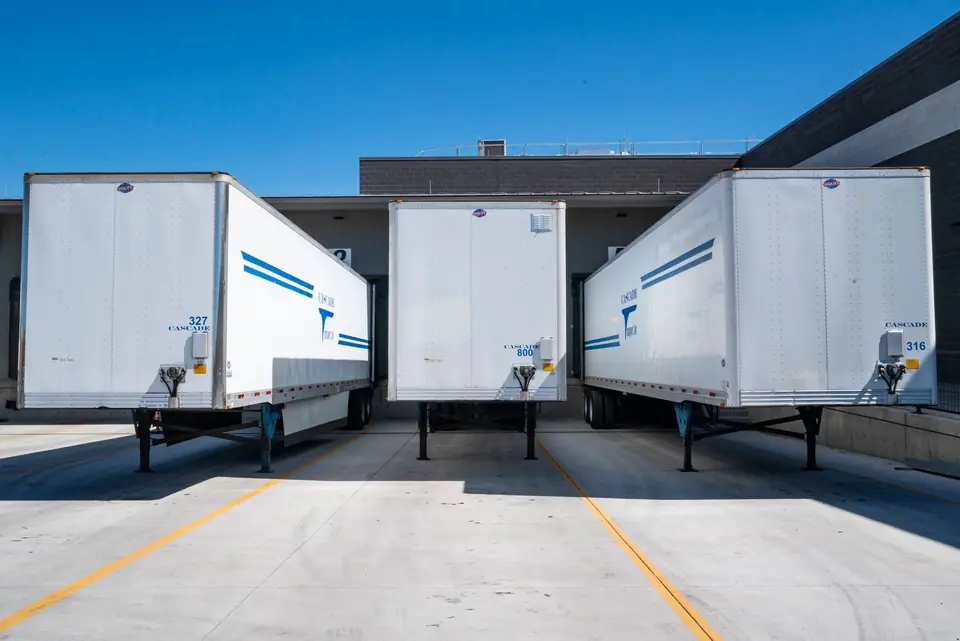
Why carriers measure to the roof
An LTL trailer earns money by filling its full volume, floor to roof. Two 44 in pallets stacked fill 88 in of a 96 in or taller box. One 44 in pallet that cannot carry anything on top leaves 52 in of air above it, and that air cannot be sold to anyone else. Carriers recover it by measuring the unit as if it reached the ceiling.
The 96 in figure is the planning height carriers use. A 53' dry van offers about 110 in of interior height and a 26' straight truck about 96 in, but door heights, load locks and roof bows make 96 in the realistic usable stack height across a mixed fleet. Every national carrier's rules tariff imputes it on non-stackable freight:
Phantom cube = L × W × (96 − H) ÷ 1,728
The imputation does not create a charge by itself. It changes the tariff cube and tariff density that feed the cubic capacity rules (350 cu ft under 3 PCF, 750 cu ft under 6 PCF) and, because non-stackable units take a full floor position each, it raises the linear feet that feed the linear foot rules.
Toggle stackable and watch the tariff cube move
- Safe — tariff cube, density and linear feet stay under the carrier's cube and linear-foot rules.
- Tier 1 — 350 cu ft or more under 3 PCF (XPO, Saia, ABF, Estes): synthetic weight of 6 lbs per tariff cubic foot.
- Re-bill — 750 cu ft or more under 6 PCF, or linear feet at the carrier's rule: book volume LTL or direct partial truckload.
What makes a unit non-stackable to a carrier
| Trigger | Why the dock flags it | Fix that usually works |
|---|---|---|
| Do not stack label | Explicit instruction; the carrier must honour it | Remove only if the freight genuinely carries a load |
| Cone, pyramid or crowned top | Nothing can sit flat on it | Corrugated or plywood cap with corner boards |
| Uneven carton heights | Stepped top, load would tip | Build to a level top, use a top sheet |
| Soft or crushable cartons | Top unit would damage it | Double-wall cartons or a rigid frame |
| Height over the carrier's line | Two units will not fit under 96 in | Build to 48 in for double stacking, or at most 60 in |
| Overhang | Edges unsupported, envelope grows | Keep product inside the pallet footprint |
The height line varies by carrier: XPO and FedEx Freight use 60 in, Old Dominion treats units from 48 to 60 in and up as unstackable depending on the unit, Saia forces 96 in on irregular tops, and ABF imputes 96 to 102 in when top-loading is restricted. Our engine treats any unit over 60 in as unstackable and any unit at 48 in or under as able to double stack.
Phantom cube by pallet height
The shorter the unit, the more phantom cube a do not stack label adds. Per unit:
| Height | 48×40 actual | 48×40 phantom | 48×48 actual | 48×48 phantom |
|---|---|---|---|---|
| 36 in | 40.0 | 66.7 | 48.0 | 80.0 |
| 44 in | 48.9 | 57.8 | 58.7 | 69.3 |
| 48 in | 53.3 | 53.3 | 64.0 | 64.0 |
| 56 in | 62.2 | 44.4 | 74.7 | 53.3 |
| 60 in | 66.7 | 40.0 | 80.0 | 48.0 |
| 72 in | 80.0 | 26.7 | 96.0 | 32.0 |
All figures in cubic feet. At 48 in the phantom cube equals the actual cube: the label exactly doubles what you are billed for. Below 48 in it more than doubles it. Whatever the height, a non-stackable 48×40 is billed as 106.7 cu ft and a 48×48 as 128 cu ft.
Worked example: the same eight skids, two labels
Eight 48×40 skids of boxed electronics, 44 in tall, 300 lbs each. Lane length 1,000 miles. Shipped once as stackable and once marked do not stack.
| Measure | Stackable | Do not stack |
|---|---|---|
| Cube per skid | 48 × 40 × 44 ÷ 1,728 = 48.9 | 48 × 40 × 96 ÷ 1,728 = 106.7 |
| Tariff cube, 8 skids | 391.1 cu ft | 853.3 cu ft |
| Phantom cube | 0 | 462.2 cu ft |
| Weight | 2,400 lbs | 2,400 lbs |
| Tariff density | 6.14 PCF (Class 125) | 2.81 PCF (Class 250) |
| Linear feet | 2 rows, 2 high: 8 LF | 4 rows, single high: 16 LF |
| 350 cu ft / 3 PCF | Clear (6.14 PCF) | Fires |
| 750 cu ft / 6 PCF | Clear (391 cu ft) | Fires |
| 12 LF line | Clear | Fires |
| Synthetic weight at 6 PCF | n/a | 5,120 lbs |
| Indicative charge | $555 clean | $1,604 re-rated |
Nothing about the freight changed. The label alone more than doubles the tariff cube, moves density from Class 125 to Class 250, doubles the floor space and trips every common rule. Indicative alternatives for the do not stack version: about $1,013 as a spot volume LTL quote and about $1,173 on a direct partial truckload. These are planning numbers, not quotes.
Fixes that work, and one that does not
- Cap the top. A corrugated or plywood top sheet with corner boards turns a crowned or stepped top into a load-bearing surface. It is the cheapest fix and the one carriers accept most readily.
- Build to 48 in. Two 48 in units fit under a 96 in ceiling. That halves floor positions and linear feet, which is what clears most linear foot rules.
- Crate it. A wood crate with a rated top converts fragile freight into stackable freight. It adds weight, which also raises density. The crated vs palletized guide works through the trade-off.
- Change the mode. On a direct partial truckload you buy floor space on one truck, dock to dock. Nothing is stacked on your freight, nothing is imputed and there is no cubic rule.
Declaring stackability on the bill of lading
The bill of lading is where the stackability call starts. Carriers rate on what they scan, but a clear declaration sets expectations and gives you evidence if the scan is wrong. For each handling unit line:
- State stackable or non-stackable in words, not just with a label on the freight.
- Give the real height at the tallest point, including the pallet and any product above the top layer.
- Price it as declared. If you declare non-stackable, quote it with the 96 in tariff cube from the start; the engine shows that figure as tariff cube.
- Photograph the top at pickup for stackable units, so a later irregular-top call can be checked against the photo.
The bill of lading dimensional checklist has a full field list, and the engine prints a dimensional manifest you can attach to the bill.
When the label should stay and the mode should change
Some freight is non-stackable and should stay that way: finished casework, medical equipment, assembled fixtures, glass, anything where a top load would cost more in damage than the cube saves. For that freight the right move is to stop paying for phantom cube in a system built around stacking.
A rough screen: if the do not stack version of your load trips a cubic or linear foot rule and the engine's partial truckload figure is below the re-rated LTL figure, move it. In the eight-skid example, about $1,173 on a partial truckload against about $1,604 re-rated is a clear call, and the freight is not touched at a cross-dock.
Carriers reissue their rules tariffs, and the current issue governs the height line and how stackability is judged. If a carrier re-bills a unit you shipped as stackable, check the item in the issue in force on the ship date before you dispute, then use the W&I dispute guide.
Carrier by carrier
Every carrier in the matrix imputes the ceiling on non-stackable freight. The differences are in the height line and in which cube tiers the imputed figure is tested against.
| Carrier | Rules tariff item | Cube / LF trigger | Height imputation | Re-rating mechanism |
|---|---|---|---|---|
| Old Dominion | ODFL 100 Item 610-1 | ≥ 750 cu ft under 6 PCF; ≥ 15 LF | Non-stackable or 48–60 in+ units cubed to 96 in | 6 lbs × cu ft at class 125/150 or minimum floor; FAK discount voided |
| XPO | CNWY 199 Item 233 | Tier 1 ≥ 350 cu ft under 3 PCF · Tier 2 ≥ 750 cu ft under 6 PCF | "Do not stack", cone-top or > 60 in cubed to 96 in | Cube × 6 PCF at applicable class with restricted discount, or flat cubic minimum |
| Saia | SAIA 170 Item 111 | ≥ 350 cu ft under 3 PCF or ≥ 750 cu ft under 6 PCF | Forced 96 in on non-stackable / irregular tops | Synthetic density weight floor + W&I inspection fee |
| FedEx Freight | FXF 100 series | ≥ 750 cu ft under 6 PCF, or 10–15+ LF | Over 60 in or non-stackable calculated at 96 in | Minimum density weight or linear-foot minimum charge |
| ABF Freight | ABF 111 Item 616 / 611 | ≥ 350 cu ft under 3 PCF or ≥ 750 cu ft under 6 PCF | Full trailer height (96–102 in) when top-loading restricted | 6 lbs/cu ft synthetic weight or cubic minimum schedule |
| Estes | EXLA 105 | ≥ 350 / ≥ 750 cu ft low-density; 12–15 LF | Non-stackable assessed full 96 in | Re-billed as capacity load / volume rate, contract discount stripped |
| R+L Carriers | RLCA 100 | ≥ 750 cu ft under 6 PCF or ≥ 12 LF | Full height imputed when freight cannot bear top weight | 750–1,000 lbs per LF synthetic floor + W&I correction |
| TForce Freight | UPGF 102 | ≥ 750 cu ft under 6 PCF | 96 in imputation on non-stackable skids | Synthetic weight adjustment + reclassification fee |
Summary of carrier rules tariff provisions as indexed by Cubic Transport. Carriers reissue rules tariffs; the current issue on the carrier's site governs any bill.
Detail and worked examples for each carrier: Old Dominion Item 610-1, XPO Item 233, and the carrier cube rules hub. To see how tall freight changes class, use the cubic feet calculator and toggle stackability on each line.