What Items 616 and 611 say in plain terms
ABF Freight, the LTL carrier of ArcBest, places its low-density provisions in the ABF 111 rules tariff. Two items work together:
- Item 616, the cubic minimum charge. Applies when a shipment reaches a published cube at low density.
- Item 611, the density minimum. Sets a minimum rated weight per cubic foot for low-density freight.
The thresholds match the two-tier pattern: 350 cu ft or more under 3.0 PCF, or 750 cu ft or more under 6.0 PCF. When either applies, ABF rates a synthetic weight of 6 lbs per cubic foot or applies the cubic minimum charge schedule, whichever the item calls for. Exactly which item governs which threshold is set by the issue in force, so read both items together.
Tier 2: tariff cu ft ≥ 750 AND PCF < 6.0
Synthetic weight = tariff cu ft × 6 lbs
ABF measures units whose top cannot be loaded at the full vertical trailer height, which it states as 96 to 102 in. Our engine uses 96 in, the lower and more common figure, so treat its tariff cube as the minimum ABF would read. Our engine also screens ABF loads at 12 linear feet, the common line for space-based rating; check ABF 111 for its own capacity provisions when a load runs long.
Run your load against ABF Items 616 and 611
- Safe — tariff cube, density and linear feet stay under the carrier's cube and linear-foot rules.
- Tier 1 — 350 cu ft or more under 3 PCF (XPO, Saia, ABF, Estes): synthetic weight of 6 lbs per tariff cubic foot.
- Re-bill — 750 cu ft or more under 6 PCF, or linear feet at the carrier's rule: book volume LTL or direct partial truckload.
Why packaging freight hits the 350 cu ft tier first
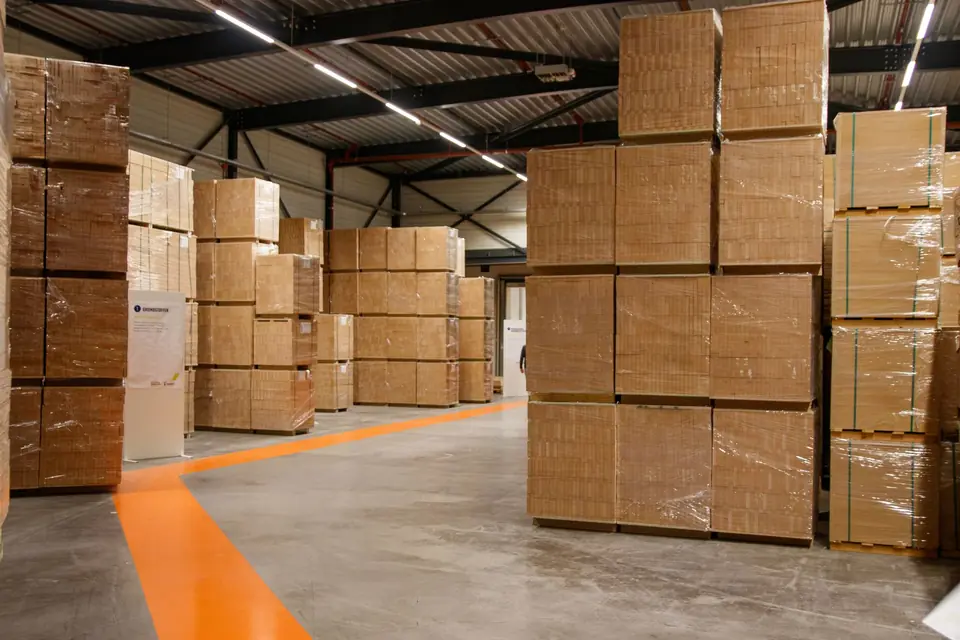
Gaylords of empty bottles, corrugated sheets, foam inserts and empty containers often run 2 to 3 PCF on real dimensions. That puts them under the tier 1 density before any imputation. The only remaining question is cube:
| Gaylords (48×40×48, stackable) | Cube | Weight at 140 lbs | Density | Tier 1 (350 / 3) |
|---|---|---|---|---|
| 5 | 266.7 cu ft | 700 lbs | 2.6 PCF | Clear, under 350 |
| 6 | 320.0 cu ft | 840 lbs | 2.6 PCF | Clear, under 350 |
| 7 | 373.3 cu ft | 980 lbs | 2.6 PCF | Fires |
Each 48×40×48 gaylord is 53.3 cu ft. Six of them total 320 cu ft and clear; the seventh takes the shipment to 373.3 cu ft. For freight at this density, the order quantity is the rule. The packaging and gaylord freight page covers the mode options for larger runs.
Worked example: the seventh gaylord
Seven 48×40×48 gaylords of empty PET bottles, 140 lbs each including the pallet, stackable two high. Lane length 650 miles.
| Measure | Calculation | Result |
|---|---|---|
| Cube per gaylord | 48 × 40 × 48 ÷ 1,728 | 53.3 cu ft |
| Total cube | 53.33 × 7 | 373.3 cu ft |
| Total weight | 140 × 7 | 980 lbs |
| Density | 980 ÷ 373.3 | 2.62 PCF (Class 250) |
| Linear feet | 2 rows (2 across, 2 high) × 48 in ÷ 12 | 8 LF |
| Tier 1 test | 373.3 ≥ 350 and 2.62 < 3.0 | Fires |
| Synthetic weight | 373.3 × 6 | 2,240 lbs |
The carrier rates 2,240 lbs instead of 980. Indicative engine figures: about $350 rated cleanly at Class 250 against about $586 re-rated under tier 1. Shipping six gaylords instead stays under 350 cu ft at about $300 clean. These are planning numbers, not quotes.
The same seven gaylords, marked do not stack
Bottles in thin-wall gaylords are often labelled do not stack. Here is what that label does to the same seven units:
| Measure | Stackable | Do not stack |
|---|---|---|
| Tariff cube | 373.3 cu ft | 746.7 cu ft |
| Phantom cube | 0 | 373.3 cu ft |
| Tariff density | 2.62 PCF | 1.31 PCF (Class 300) |
| Linear feet | 8 LF | 16 LF |
| Synthetic weight | 2,240 lbs | 4,480 lbs |
| Indicative re-rated charge | $586 | $1,106 |
The label doubles the tariff cube, halves the density and doubles the floor space. At 746.7 cu ft the shipment sits 3.3 cu ft under the 750 tier, but tier 1 is already firing and 16 LF is past any linear foot line. Indicative alternatives on this lane: about $658 as spot volume LTL and about $762 on a direct partial truckload, both well below the re-rate. Using double-wall gaylords with a top sheet so they can carry a second unit is the cheapest fix of all.
Planning ABF shipments around the tiers
| Load profile | ABF result | Recommendation |
|---|---|---|
| Under 350 tariff cu ft | Scale weight | Ship ABF LTL |
| 350–749 tariff cu ft, 3 PCF or more | Scale weight on cube | Ship ABF LTL if under 12 LF |
| 350–749 tariff cu ft, under 3 PCF | Tier 1 | Cap order at the unit count under 350, or use a single-tier carrier, or spot volume LTL |
| 750+ tariff cu ft, under 6 PCF | Tier 2 | Direct partial truckload |
For a recurring light commodity, the most useful number to give your order desk is the unit count that stays under 350 cu ft. For 48×40×48 gaylords it is six. For 48×40×60 it is five (333.3 cu ft). For non-stackable 48×40 units of any height it is three (320 cu ft).
Reading an ABF corrected invoice
A cubic re-bill from ABF arrives as a corrected freight bill with an inspection record. The lines worth checking, and what each should show if Item 616 or 611 was applied correctly:
| Invoice line | What it should show | Red flag |
|---|---|---|
| Handling units | Same count as your bill of lading | Extra unit from another shipment |
| Dimensions | Scan per unit, height at 96–102 in only if restricted | Full height on a capped, stackable unit under the line |
| Cubic feet | Sum of L × W × H ÷ 1,728 | Total that does not reproduce |
| Density | Scale weight ÷ tariff cube | Weight from a different scale ticket |
| Rated weight | Tariff cube × 6 lbs, or the minimum charge | Multiplier that differs from the current item |
| Discount | Restricted or removed per the item | Discount removed where the item does not say so |
Most of these checks take five minutes with the scan in front of you. If every line reproduces from the scanned dimensions and the current item, the charge is correct and the fix belongs in the next tender, not in a claim.
Commodities at the most risk on ABF
Because ABF publishes the 350 cu ft tier, any commodity that runs under 3 PCF at its tariff height is exposed even on small orders. Profiles worth flagging on your order desk:
- Empty bottles, preforms in light gaylords, nested containers: about 2 to 3 PCF; six standard gaylords is the safe limit.
- Foam, insulation and packaging inserts: often under 2 PCF (Class 300 or 400); three or four units can reach 350 cu ft.
- Spiral duct and plenums: tall, hollow and unstackable; see the HVAC ductwork page.
- Assembled chairs and lightweight furniture: crowned tops force 96 in measurement.
For these, set a maximum unit count per ABF shipment and route anything above it as volume LTL or partial truckload before it reaches the dock. A one-line rule on the order screen, such as "over six gaylords: call rates@cubictransport.com", stops more re-bills than any dispute process. Review the limit whenever the packaging changes, because a switch from double-wall to single-wall gaylords can take a stackable unit to do not stack overnight.
Checking ABF 111 before you dispute
ABF reissues ABF 111 like every carrier reissues its rules tariff, and the current issue governs. Item numbers 616 and 611, the thresholds and the cubic minimum charge schedule can change between issues. Before you dispute, pull the issue in force on your ship date and read both items.
- Request the inspection record and dimensioner photos.
- Check the height ABF used. If the unit was restricted from top-loading, confirm whether 96 or 102 in was applied and why.
- Rebuild the cube and density from the scanned dimensions and compare with the tier used.
The W&I dispute guide has the filing steps.