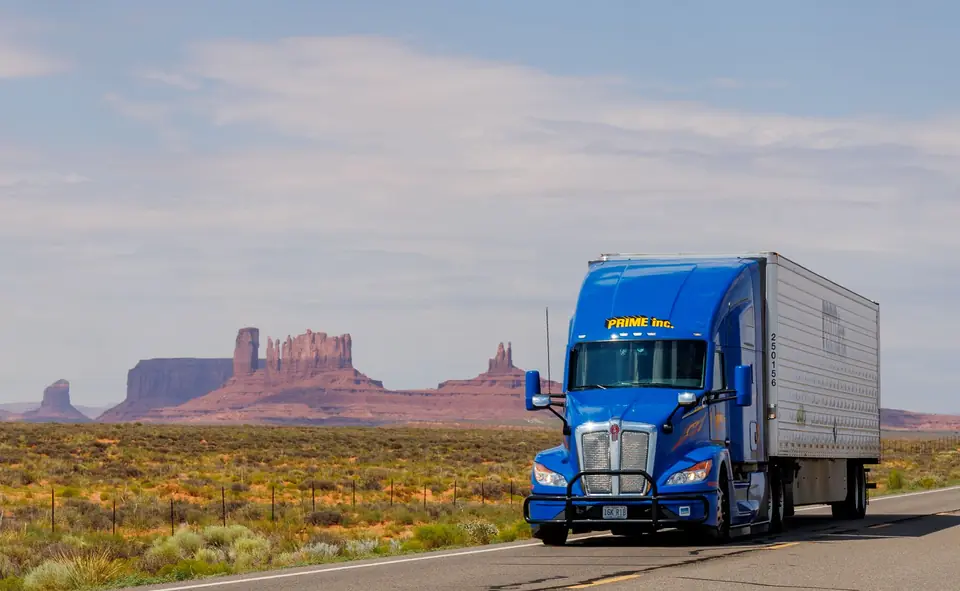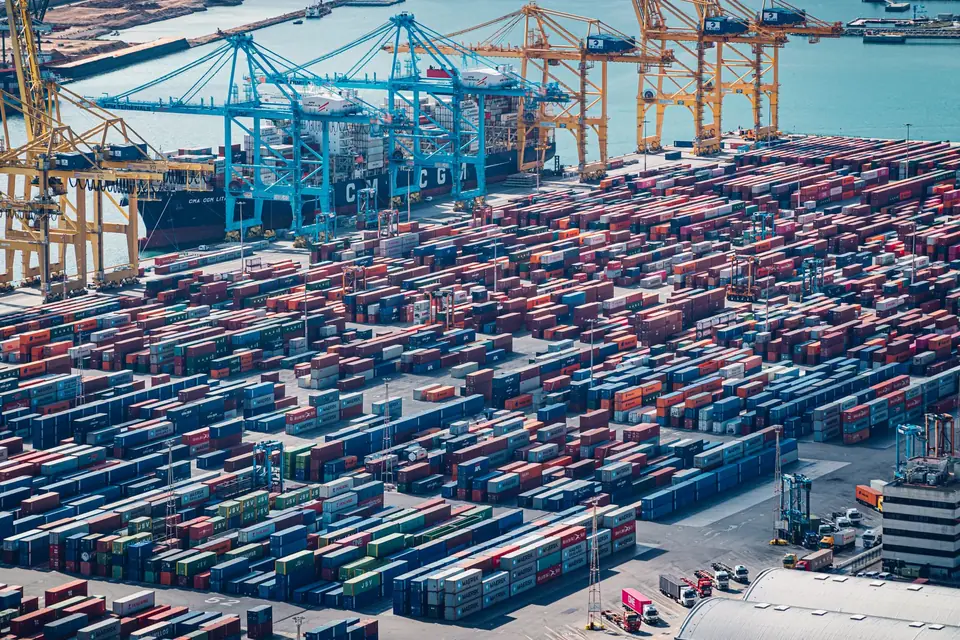
The corridor: ports, the Inland Empire and the desert lanes
The Ports of Los Angeles and Long Beach together form the largest container gateway in North America. Containers leave the San Pedro Bay terminals on I-710 and I-110, and most head 50 to 60 miles east to the Inland Empire, the warehouse region around Ontario, Fontana, Rialto, Riverside, Perris and Moreno Valley. There, import loads are unloaded, sorted and rebuilt on pallets in transload and distribution warehouses, then shipped out in 53' trailers.
The outbound spines:
- I-10 east from Ontario through Banning Pass and Palm Springs to Phoenix, Tucson and El Paso; the main route to Texas and the southern U.S.
- I-15 north over Cajon Pass to Barstow, Las Vegas and Salt Lake City, and south to San Diego.
- I-40 from Barstow east to Flagstaff, Albuquerque and Oklahoma City; the main route toward Chicago with I-44 and I-55.
- I-5 north over Tejon Pass (the Grapevine) into the Central Valley and the Bay Area, and south to San Diego.
- SR-60 and I-210, the local east–west arteries connecting the ports, the San Gabriel Valley and the Inland Empire.
Phoenix is part of the same freight system: a fast-growing distribution and manufacturing market 330 miles east of Ontario, increasingly used as an overflow warehouse market for Southern California and as the hub for Arizona, New Mexico and Las Vegas.
Lane table: Southern California mileage and transit days
Approximate highway miles; direct PTL at about 500 miles per driver day, LTL with terminal days added. Long-haul transcontinental lanes are included because much Inland Empire freight leaves the region entirely.
| Lane | Main route | Approx. miles | Direct PTL | LTL via terminals |
|---|---|---|---|---|
| Port of LA/Long Beach – Ontario, CA | I-710 / SR-60 | 55 | Same day | 1 day |
| Los Angeles – San Diego | I-5 | 120 | Same day | 1–2 days |
| Ontario, CA – Las Vegas, NV | I-15 | 230 | Same day / next morning | 1–2 days |
| Ontario, CA – Phoenix, AZ | I-10 | 330 | 1 day | 2 days |
| Los Angeles – Oakland / Bay Area | I-5 | 370 | 1 day | 2 days |
| Los Angeles – Phoenix, AZ | I-10 | 372 | 1 day | 2 days |
| Los Angeles – Tucson, AZ | I-10 | 485 | 1 day | 2 days |
| Ontario, CA – Salt Lake City, UT | I-15 | 650 | 2 days | 2–3 days |
| Los Angeles – Dallas, TX | I-10 / I-20 | 1,435 | 3 days | 4–5 days |
| Los Angeles – Chicago, IL | I-40 / I-44 / I-55 | 2,015 | 4–5 days solo | 5–6 days |
California's truck speed limit is 55 mph for vehicles with three or more axles, which is slower than the posted car limit on rural interstates and slower than Arizona or Nevada. That is why a 330-mile Ontario-to-Phoenix run takes most of a driving day even without traffic, and why we plan Southern California lanes a little more conservatively than the 500-mile rule suggests.
Transload freight and why it lands in the PTL range
A 40' high cube container holds about 2,694 cu ft; a 53' dry van holds about 3,950. Transload warehouses exist to exploit that gap: three 40' containers of floor-loaded cartons typically rebuild into two 53' trailers, cutting the over-the-road cost by about a third. But the rebuild also splits freight by destination, and that is where partial loads appear.
- Split destinations. An importer's container holds product for four regional DCs. After sorting, each DC's share might be 6 to 18 pallets: textbook direct PTL or volume LTL.
- Palletizing adds height. Floor-loaded cartons stacked 100 inches high in a container are rebuilt on 48×40 pallets at 60 to 80 inches. The cube grows by the pallet and the air, and most rebuilt skids end up over 60 inches, which carriers treat as non-stackable.
- Light consumer goods. Housewares, toys, decor, furniture and seasonal goods typically run 3 to 7 PCF, squarely in the cube-penalty zone.
Our CBM to cubic feet converter turns an ocean packing list into domestic cube, and the 40' HC loading guide covers how container cube maps onto trailer floor.
Seasonal capacity and the mountain passes
Southern California is a headhaul market outbound: more freight leaves the Inland Empire than arrives, so outbound rates are firm most of the year and inbound loads from Phoenix and Las Vegas are often priced as backhauls. The seasons that move it:
| Window | Effect |
|---|---|
| August – October | Retail import peak at LA/Long Beach; transload labor, drayage and outbound 53' capacity all tighten |
| Weeks after Lunar New Year | Import volume usually dips as Asian factories close, loosening Inland Empire outbound capacity for a few weeks |
| April – October | California produce from the Imperial and Coachella valleys, then the Central Valley and Salinas; reefers leave the dry van pool |
| December – March | Snow and ice close Tejon Pass on I-5 and Cajon Pass on I-15 for hours at a time; trucks reroute or wait |
| Summer | Desert heat on I-10 and I-15; heat-sensitive goods may need a reefer in protect mode |
| Fire season, late summer and fall | Wildfires occasionally close I-5, I-15 or SR-138 with little notice |
California also has its own emissions rules for trucks operating in the state, enforced by the California Air Resources Board. Carriers we tender to on California lanes must meet them; it narrows the pool of out-of-state trucks somewhat and is one reason California intrastate rates run higher than mileage alone would predict.
Equipment availability
- 53' dry vans: the largest pool in the West, concentrated in the Inland Empire. Outbound is the competitive side; inbound from Arizona and Nevada is usually easier to cover.
- 26' box trucks: plentiful across greater Los Angeles for urban deliveries where 53' trailers cannot reach a dock; Los Angeles, Orange County and San Diego all have street and dock restrictions that favor straight trucks.
- Drayage: large but cyclical; chassis and terminal appointments set the pace in peak season. We broker the over-the-road leg after the container reaches a transload warehouse.
- Flatbeds: available but less abundant than in Texas; steel and machinery from the ports compete with construction loads.
- Reefers: abundant outside produce peaks, scarce during them.
Worked example: 18 rebuilt import skids, Ontario to Phoenix (330 miles)
Eighteen 48×40 skids of transloaded housewares, rebuilt at 70 inches tall, 300 lbs each. At 70 inches they are too tall to double-stack, so carriers impute 96 inches. Rated against Estes' EXLA 105 thresholds (350 and 750 cu ft low-density tiers, 12 linear feet).
| Measure | Value | Working |
|---|---|---|
| Actual cube | 1,400.0 cu ft | 48 × 40 × 70 ÷ 1,728 = 77.78 × 18 |
| Imputed cube at 96 in | 1,920.0 cu ft | 106.67 × 18 |
| Weight | 5,400 lbs | 300 × 18 |
| Actual density | 3.86 PCF · Class 250 | 5,400 ÷ 1,400 |
| Imputed density | 2.81 PCF · Class 250 | 5,400 ÷ 1,920 |
| Linear feet | 36.0 LF | 9 rows × 48 in ÷ 12 |
| Synthetic weight | 11,520 lbs | 1,920 × 6 PCF |
Indicative costs at 330 miles:
| Mode | Indicative cost | Transit |
|---|---|---|
| Standard LTL as booked (Class 250) | $1,412 | 2 days |
| Standard LTL after cubic capacity re-bill | $2,023 | 2 days |
| Spot volume LTL | Not offered over 28 LF | n/a |
| Direct partial truckload | $618 | 1 day |
| 53' full truckload | $809 | 1 day |
At 36 linear feet the load uses about 69% of a 53' trailer. Volume LTL is off the table because carrier volume desks generally stop at about 28 linear feet, and the 26' box truck is excluded because 36 feet will not fit it. Direct PTL at $618 is $191 below a whole 53' truck at $809, $794 below the as-booked LTL price and $1,405 below the re-bill. The lesson for transload freight: a rebuilt load past 28 linear feet leaves the LTL world entirely, and the comparison becomes direct PTL against a full truckload; the closer it gets to a full floor, the narrower the gap. Indicative figures from our cost model; carriers reissue rules tariffs and the current EXLA 105 issue governs.
Run an Inland Empire load: Ontario to Phoenix is 330 miles
- Safe — tariff cube, density and linear feet stay under the carrier's cube and linear-foot rules.
- Tier 1 — 350 cu ft or more under 3 PCF (XPO, Saia, ABF, Estes): synthetic weight of 6 lbs per tariff cubic foot.
- Re-bill — 750 cu ft or more under 6 PCF, or linear feet at the carrier's rule: book volume LTL or direct partial truckload.