Trailer load planner
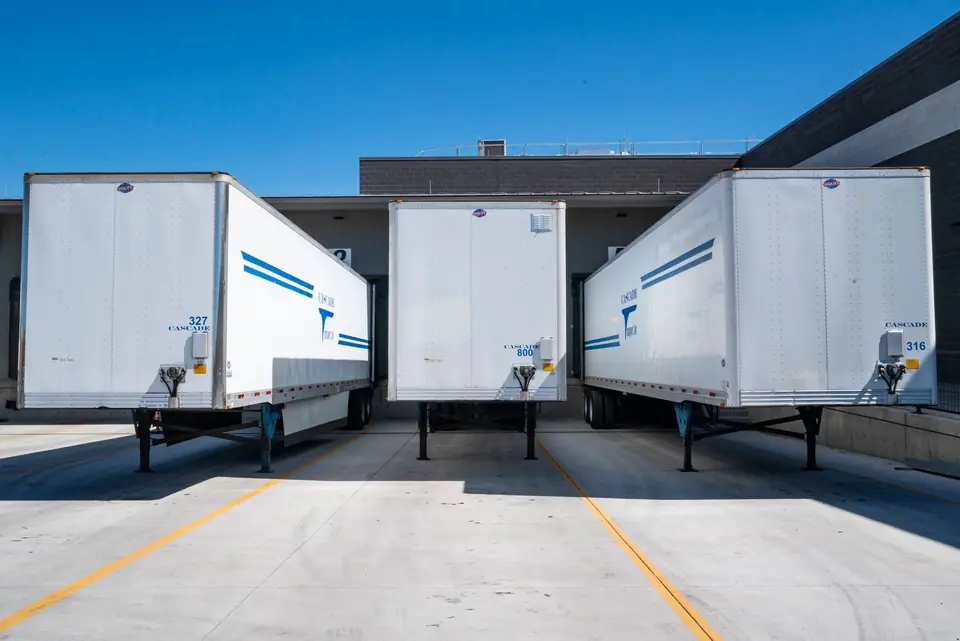
Choose the equipment, the footprint of your units and how many you are shipping. The planner draws three floor plans: straight (the long side along the trailer), turned (the narrow side along the trailer, two across) and pinwheeled (alternating orientation, row by row). Yellow positions are your units; white positions are space still available to another shipper — the space a partial truckload lets you stop paying for.
With 48×40 GMA pallets in a 53-foot dry van (about 630 inches of usable floor and 98.5 inches between the walls) the planner gives 26 straight, 30 turned and 28 pinwheeled positions. Turned loading needs 96 inches across, which a 98.5-inch van accepts but an older 96-inch-wide trailer or a straight truck with E-track posts may not.
Linear feet, cube and carrier linear-foot rule check
- Safe — tariff cube, density and linear feet stay under the carrier's cube and linear-foot rules.
- Tier 1 — 350 cu ft or more under 3 PCF (XPO, Saia, ABF, Estes): synthetic weight of 6 lbs per tariff cubic foot.
- Re-bill — 750 cu ft or more under 6 PCF, or linear feet at the carrier's rule: book volume LTL or direct partial truckload.
The linear foot formula
Ten non-stackable 48×40 skids loaded straight: two across, five rows, 5 × 48 ÷ 12 = 20 linear feet. The same ten units turned (40 inches along the length) need 5 × 40 ÷ 12 = 16.7 linear feet — worth asking for on a linear-foot-priced partial. Stack them two high and the straight footprint drops to three rows, or 12 linear feet.
| 48×40 units | Non-stackable, straight | Non-stackable, turned | Stackable ×2, straight |
|---|---|---|---|
| 4 | 8 LF | 6.7 LF | 4 LF |
| 6 | 12 LF | 10 LF | 8 LF |
| 8 | 16 LF | 13.3 LF | 8 LF |
| 10 | 20 LF | 16.7 LF | 12 LF |
| 12 | 24 LF | 20 LF | 12 LF |
| 18 | 36 LF | 30 LF | 20 LF |
| 26 | 52 LF | 43.3 LF | 28 LF |
Carrier linear-foot thresholds
Linear-foot rules exist because a load can be light and still fill the floor. Most national LTL carriers let themselves re-rate a shipment once it occupies roughly 10 to 15 linear feet, either at a per-linear-foot minimum, as a capacity load, or by applying a synthetic weight per linear foot (750–1,000 lbs per foot is common in rules tariffs).
| Carrier | Rules tariff | Linear-foot rule used by the engine |
|---|---|---|
| Old Dominion | ODFL 100 Item 610-1 | 15 LF |
| XPO | CNWY 199 Item 233 | 12 LF |
| FedEx Freight | FXF 100 series | 12 LF (10–15 by service) |
| Estes | EXLA 105 | 12 LF |
| R+L Carriers | RLCA 100 | 12 LF |
Carriers reissue rules tariffs; the current issue governs. Check the item before you dispute a bill.
Straight, turned or pinwheeled: which to request
- Straight is the default at most docks: forklift forks enter the 40-inch side, pallets go nose to tail two across. Easy to load and count, wastes about 18 inches of width in a 98.5-inch van.
- Turned loads every pallet with the 48-inch side across the trailer. It fits 30 GMA pallets in a 53-foot van and reduces linear feet by one sixth, but needs a full 96 inches of clear width and pallets that can be forked from the 48-inch side (four-way entry).
- Pinwheeled alternates one straight and one turned pallet per row, filling 88 inches across with fewer gaps; it reaches 28 positions and suits mixed docks where turned loading is not possible for every unit.
When linear feet should change the mode
Under about 8 linear feet, dense freight is almost always cheapest as class-rated LTL. Between 12 and 24 linear feet, ask for a spot volume LTL quote and a direct partial truckload quote on the same freight: volume desks price the floor space and skip cube re-bills, while a partial skips terminals entirely. Above roughly 26 linear feet — half a 53-foot trailer — a dedicated truck or a partial priced close to it is usually the better buy, and above 40 linear feet a full truckload almost always wins.
Run the numbers on the LTL vs. partial truckload analyzer, or see how the same pallets fill other equipment on the trailer and container capacity chart.