When open-deck partial freight is the right call
A dry van loads from the rear, through a door about 98 inches wide, onto a floor that a forklift drives across. Freight that cannot work that way belongs on an open deck:
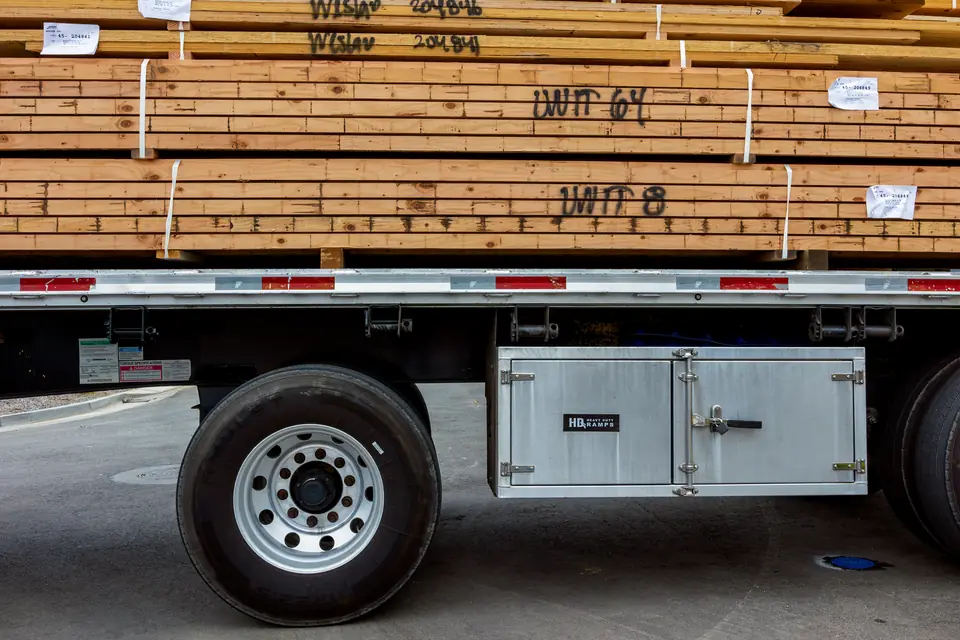
- Side loading. Long crates, bundled lumber, pipe and steel that a forklift has to pick from the side.
- Crane or overhead loading. Machinery, transformers, tanks and precast that come off with a crane or gantry.
- Tall or wide units. Anything over the van door height, or wider than about 96 inches.
- Heavy point loads. Machines on skids that would stress a van floor.
Most of that freight does not fill a deck. A pair of electrical enclosures, six crated compressors or a bundle of structural steel may use 16 to 30 feet of a 48-foot flatbed, which is why open-deck partials exist. Carriers combine two or three partials on a lane the same way van carriers do, priced on deck feet.
Cubic Transport tenders open-deck partials to flatbed, step-deck and Conestoga carriers. We do not own trailers; we spec the deck, the securement and the tarping, and manage the load to delivery.
Deck dimensions and legal freight heights
| Trailer | Deck length | Deck width | Typical deck height | Max freight height (13'6" overall) | Typical payload |
|---|---|---|---|---|---|
| 48' flatbed | 48' | 102" | ~60" | ~8'6" | ~46,000–48,000 lbs |
| 53' flatbed | 53' | 102" | ~60" | ~8'6" | ~45,000–47,000 lbs |
| 48'–53' step deck | ~10' upper + 37–43' lower | 102" | ~36–42" lower | ~10' on the lower deck | ~43,000–46,000 lbs |
| 48'–53' Conestoga | 48–53' | ~98–100" inside the kit | ~60" (flatbed) or step deck | ~8' inside the kit on a flatbed | A few thousand lbs less than the bare deck |
All figures are typical; trailers vary by builder and the kit fitted. Overall height is limited to 13 feet 6 inches in most states, with some western states allowing 14 feet, so freight height is that limit minus the deck height. Width over 102 inches, or height over the limit, needs oversize permits and usually a full truckload rather than a partial.
A 48-foot flatbed holds 24 GMA pallets straight (2 across × 12 rows of 48 inches) or 28 turned (14 rows of 40 inches), but pallets on open deck are usually a minority; most open-deck partials are crates, bundles and machines measured in deck feet.
Size your crates on a deck
- Safe — tariff cube, density and linear feet stay under the carrier's cube and linear-foot rules.
- Tier 1 — 350 cu ft or more under 3 PCF (XPO, Saia, ABF, Estes): synthetic weight of 6 lbs per tariff cubic foot.
- Re-bill — 750 cu ft or more under 6 PCF, or linear feet at the carrier's rule: book volume LTL or direct partial truckload.
Worked example: six crates on a 48-foot deck, 700 miles
Six crated air compressors, each 96×48×72 inches and 1,800 lbs, need side loading at a plant without a dock. This is the engine preset on this page.
- Cube. 96 × 48 × 72 = 331,776 ÷ 1,728 = 192 cu ft per crate × 6 = 1,152 cu ft.
- Weight and density. 6 × 1,800 = 10,800 lbs ÷ 1,152 = 9.38 PCF, Class 100.
- Deck feet. Two across is 96 inches on a 102-inch deck. Three rows of 96 inches = 288 inches, 24 deck feet, half of a 48-foot flatbed.
- Height. 72 inches on a 60-inch deck is 132 inches, 11 feet overall, well under 13 feet 6 inches.
- Securement. Each crate is longer than 5 feet and not over 10 feet, so it needs at least two tiedowns if not blocked at the front: twelve tiedowns minimum. Aggregate working load limit must be at least half the cargo weight, 900 lbs per crate, 5,400 lbs for the load.
- Cost. In our model, which uses dry-van rates, 24 feet over 700 miles is about $1,017 as a partial and $1,715 as a full truckload. Open-deck rates on a given lane can run higher, and tarping adds a charge.
For comparison, the same crates in LTL would be cubed at 96 inches as non-stackable units: 1,536 cu ft at 7.03 PCF, with 24 linear feet tripping the 12-foot rule, and most LTL terminals cannot side-load them anyway.
Securement and tarping
Cargo securement on open deck follows the FMCSA rules in 49 CFR Part 393, Subpart I. The minimum tiedown count for an article not blocked at the front by a headboard or other cargo is:
| Article | Minimum tiedowns |
|---|---|
| 5 ft or shorter and 1,100 lbs or less | 1 |
| 5 ft or shorter and over 1,100 lbs | 2 |
| Over 5 ft, up to 10 ft | 2 |
| Over 10 ft | 2, plus 1 for each additional 10 ft or part of it |
The aggregate working load limit of all tiedowns must be at least half the weight of the cargo, and specific commodities such as metal coils, machinery and lumber have their own rules. Drivers apply edge protectors where straps cross crate corners; crates should be built with top members that can take strap pressure.
Tarps protect freight from rain and road grime. Lumber tarps drape over tall loads, steel tarps are smaller for low loads, and smoke tarps cover the front of a load. Flatbed carriers usually charge for tarping, and it adds time at pickup. If the freight must stay dry and cannot be tarped well, a Conestoga is the cleaner answer.
How an open-deck partial is priced
Open-deck carriers sell deck feet the same way van carriers sell linear feet, with a few extra factors that do not apply in a van.
| Factor | Effect | Why |
|---|---|---|
| Deck feet used | Primary driver | What is left is what the carrier can sell to another shipper |
| Position on the deck | Moderate | Heavy pieces have to sit where the axles can carry them, which limits what else fits |
| Tarping | Added charge | Tarps take time and labour at pickup, and the driver supplies them |
| Loading method | Moderate | Crane picks and side loads need a set appointment and a site that can do them |
| Width and height | Large near the limits | Anything over 102 inches wide or over legal height needs permits, which rules out most partials |
| Lane and season | Large | Open-deck demand follows construction and is seasonal in most regions |
The practical lesson is to describe the freight completely at tender. A flatbed carrier that finds a crate 4 inches wider than quoted, or a machine that needs a crane the site does not have, cannot simply add it to the load. A complete description gets a price that holds.
Conestoga, tarped flatbed or dry van?
| Tarped flatbed | Conestoga | Dry van | |
|---|---|---|---|
| Loading | Side, top, rear | Side or top with the kit rolled back | Rear only |
| Weather protection | Good if tarped well | Enclosed | Enclosed |
| Freight height | ~8'6" | ~8' inside the kit | ~100–110" at the door |
| Securement | Straps and chains by the driver | Straps and chains by the driver | Load bars, straps |
| Availability | Wide | Narrower; priced at a premium | Widest |
| Best for | Steel, lumber, machinery | Crated machinery, finished goods that need side loading | Palletized freight with a dock |
If your freight can be rear-loaded with a forklift through a 98-inch door, a dry van is usually cheaper and easier to source. Choose open deck when the loading method or the size demands it. See industrial machinery and electrical enclosures for tall-skid cases.
How Cubic Transport tenders an open-deck partial
- Measure each piece. Length, width, height and weight, plus the centre of gravity for top-heavy units and where lifting points or fork pockets are.
- State the loading method. Forklift from the side, crane, or dock. Say what equipment is on site at pickup and delivery.
- Specify protection. Tarp type, Conestoga, edge protection, or no tarp needed.
- Plan the deck. Deck feet used, position (front, middle, rear) and how the freight is secured relative to any other partial on the trailer.
- Tender and track. To an open-deck carrier on the lane, with windows at both ends, through to signed delivery.
Send drawings or crate specs with your request to rates@cubictransport.com, or use the tender form.