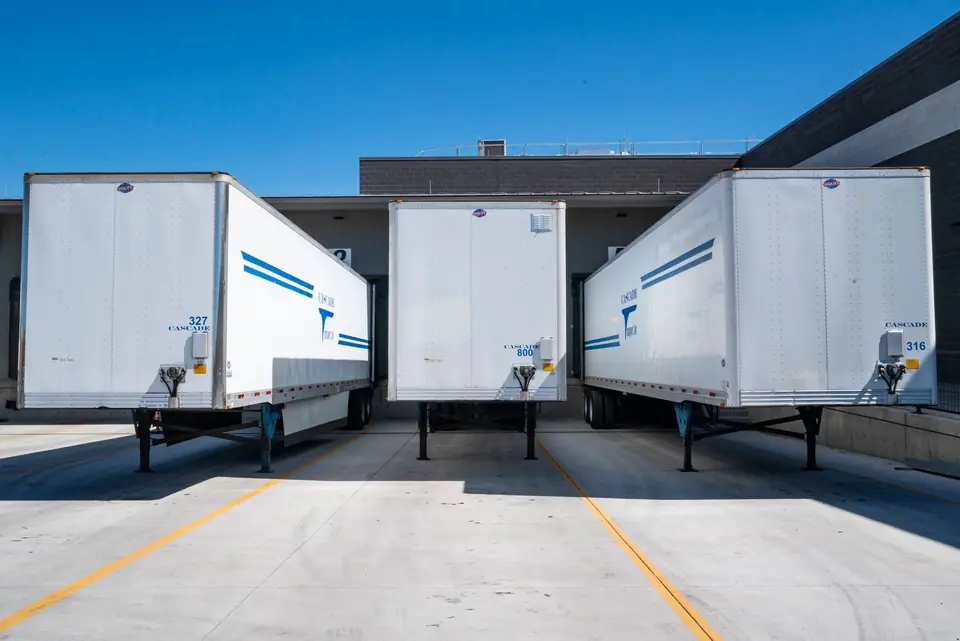
Five modes, one question: how much trailer does your freight use?
Every freight mode sells the same thing in a different unit: space on a trailer floor and room under its roof. Standard LTL sells it by the hundredweight at a freight class. Volume LTL sells a slice of a linehaul trailer by linear feet and weight. Direct partial truckload sells floor space on a truck that runs from your dock to the consignee's dock without a terminal in between. A 26-foot box truck and a 53-foot dry van sell the whole box.
The trouble with bulky freight is that the unit you were billed in can change after pickup. A pallet that weighs 280 lbs and stands 60 inches tall looks like cheap class-rated LTL on the bill of lading. Once it crosses a carrier dimensioner marked "Do Not Stack", the carrier counts the air above it up to the 96-inch trailer ceiling, and the shipment that was booked by weight gets re-rated by cube or by linear feet. That is why mode choice for high-cube freight is a measurement problem first and a pricing problem second.
Cubic Transport is a freight brokerage. We do not own trucks. We measure the load with you, pick the mode that fits its real footprint, and tender it to a carrier whose equipment and network suit that mode: an LTL carrier's volume desk, a regional partial carrier, a box truck operator or a truckload carrier. The sections below show how we draw those lines.
Mode thresholds at a glance
The ranges below are the working bands we use when a load first lands on the desk. They overlap on purpose: a 10-pallet load can move well in three different modes, and the deciding factors are density, stackability, distance and how much handling the freight can take.
| Mode | Typical pallets (48×40) | Linear feet | Cubic feet | Weight | Priced by | Terminal handling |
|---|---|---|---|---|---|---|
| Standard class-rated LTL | 1–6 | Under 12 | 50–349 | 150–7,500 lbs | Class and weight, FAK discount | Origin and destination cross-docks, often a break-bulk |
| Spot volume LTL | 6–12 | 12–24 | 350–1,650 | 5,000–18,000 lbs | Linear feet and weight, per quote | Same LTL network, fewer re-handles |
| Direct partial truckload | 6–18 | 12–36 | 750–2,600 | 6,000–28,000 lbs | Deck space and miles | None, dock to dock |
| 26' box truck (dedicated) | Up to 12 | Up to 26 | 1,664–1,800 | Up to 10,000–12,500 lbs | Miles, with a minimum | None, exclusive use |
| 53' dry van truckload | 26 floor / 52 stacked | Up to 52.5 | 3,800–4,054 | Up to 44,000–45,000 lbs | Miles, all-in | None, exclusive use |
Two numbers on this table do most of the work. The first is 12 linear feet, the point where most national LTL carriers stop treating a shipment as ordinary class-rated freight and start applying capacity or linear-foot rules. The second is 750 cubic feet under 6 PCF, the cubic capacity trigger written into nearly every major LTL rules tariff. A load past either line is a volume LTL, partial or truckload decision, whether the shipper books it that way or not.
How carriers measure your shipment before they price it
LTL terminals now run legal-for-trade dimensioners over the inbound dock. The scan records length, width and height for each handling unit, and the rules tariff decides which height counts. Three rules decide most re-bills on bulky freight:
- The 96-inch imputation. A unit marked non-stackable, or taller than about 60 inches, is cubed as if it rose to the 96-inch trailer ceiling, because nothing can ride on top of it. See the non-stackable 96-inch rule for how that is written in each tariff.
- Cubic capacity triggers. Carriers such as XPO, Saia, ABF and Estes apply a lower tier at 350 cubic feet under 3 PCF and a higher tier at 750 cubic feet under 6 PCF; Old Dominion, FedEx Freight, R+L and TForce key on the 750 cubic feet under 6 PCF tier. The full matrix is on carrier cubic capacity rules.
- Linear foot rules. A shipment that occupies 12 or more linear feet of trailer (15 at Old Dominion) is rated on the space it takes, not on its class.
When a rule fires, the carrier typically replaces scale weight with a synthetic weight of 6 lbs per imputed cubic foot, restricts the FAK discount and adds a weight and inspection correction fee. None of that happens in a direct partial truckload or a dedicated truck, because those modes are priced on space from the start.
Worked example: eight non-stackable skids, 900 miles
Eight 48×40 skids of commercial light fixtures, each 60 inches tall and 280 lbs including the pallet, marked "Do Not Stack", moving 900 miles. This is the load preset in the engine on this page.
- Measured cube. 48 × 40 × 60 = 115,200 cubic inches ÷ 1,728 = 66.67 cu ft per skid; × 8 = 533.3 cu ft.
- Actual density. 8 × 280 = 2,240 lbs ÷ 533.3 cu ft = 4.20 PCF, which is Sub 4 on the 13-tier scale: Class 175.
- Tariff cube. Non-stackable, so the height counts as 96 inches: 48 × 40 × 96 ÷ 1,728 = 106.67 cu ft × 8 = 853.3 cu ft. Density at tariff cube is 2,240 ÷ 853.3 = 2.63 PCF.
- Triggers. 853.3 cu ft is over 750 at under 6 PCF and over 350 at under 3 PCF. Two across in four rows of 48 inches is 192 inches, or 16 linear feet, past the 12-foot line.
- Synthetic weight. 853.3 × 6 = 5,120 lbs, more than double the scale weight.
| Mode | Indicative cost, 900 miles | What drives it |
|---|---|---|
| Standard LTL as booked (Class 175) | $678 | 2,240 lbs at Class 175 with FAK discount |
| Standard LTL after cube re-rate | $1,504 | 5,120 lbs synthetic, restricted discount, W&I fee: $826 re-bill |
| Spot volume LTL | $911 | 16 linear feet, quoted up front |
| Direct partial truckload | $1,055 | 16 linear feet, no terminal |
| Dedicated 26' box truck | $2,115 | Whole truck for 62% of its floor |
| 53' dry van truckload | $2,205 | Whole trailer for 30% of its floor |
The "as booked" figure is the number that misleads people. It is not available for this freight; the carrier's dimensioner will see 853 cubic feet. The honest comparison is the re-rated $1,504 against $911 for volume LTL and $1,055 for direct partial. Volume LTL is cheapest here, but the skids still cross two or three docks. For light fixtures that bruise easily, the extra $144 for a dock-to-dock partial is usually the better buy. These are planning figures from our cost model, not quotes; live rates move with lane balance and season.
Run your skids against every mode
- Safe — tariff cube, density and linear feet stay under the carrier's cube and linear-foot rules.
- Tier 1 — 350 cu ft or more under 3 PCF (XPO, Saia, ABF, Estes): synthetic weight of 6 lbs per tariff cubic foot.
- Re-bill — 750 cu ft or more under 6 PCF, or linear feet at the carrier's rule: book volume LTL or direct partial truckload.
When each mode wins
- Standard LTL wins for dense, stackable freight under about 8 linear feet and under 350 cubic feet. Four 48-inch stackable pallets at 600 lbs each (213 cu ft, 11.25 PCF, Class 92.5, 4 linear feet stacked) trip nothing and price around $384 for 900 miles in our model.
- Volume LTL wins for dense or stackable freight that occupies 12 to 24 linear feet and can tolerate terminal handling: palletized cartons, boxed parts, bagged goods. See spot volume LTL shipping.
- Direct partial truckload wins for light, tall, fragile or non-stackable freight between about 12 and 36 linear feet, where a cube re-rate is likely and every re-handle is a damage risk. See direct partial truckload.
- Shared truckload is partial freight co-loaded with other shippers on one van, planned by stop order. See shared truckload shipping.
- A 26-foot box truck is the pick on short hauls under roughly 400 miles when the freight needs a liftgate, tight-access delivery, or one driver, one handler and no co-load. It usually costs more than a partial, and earns it on handling and timing.
- A 53-foot truckload becomes the better buy past roughly 30 to 34 linear feet, where a partial costs most of a truckload but still shares the trailer and adds stop time, and it is the only option past 26 floor positions or about 20,000 lbs of partial weight. See 53-foot high-cube truckload.
Handling, transit and claims differences
Price is only one column. The other is how many times a forklift touches your freight. A class-rated LTL shipment is picked up on a city route, unloaded at the origin terminal, often reloaded at a break-bulk, unloaded again at the destination terminal and put on a delivery truck. Each move is a chance for a fork tine through a carton, a pallet set on top of a non-stackable unit, or a shrink-wrapped skid split in two. Volume LTL usually skips some of that because the shipment fills a meaningful part of the trailer, but it still rides the LTL network.
Direct partial truckload, shared truckload, box truck and full truckload load once at your dock and unload once at the consignee. Transit on a direct partial is close to truckload transit on the same lane, plus time for any other pickup or delivery on the run. Class-rated LTL transit is set by the carrier's terminal schedule and can run one to three days longer on long lanes.
| Mode | Typical handlings | Transit basis | Re-rate exposure |
|---|---|---|---|
| Standard LTL | 3–5 | Terminal schedule | High for bulky freight |
| Volume LTL | 2–4 | Terminal schedule | Low if dimensions match the quote |
| Direct partial / shared | 2 | Truckload, plus stops | None on cube; priced on space |
| Box truck / 53' truckload | 2 | Truckload, direct | None |
How Cubic Transport tenders a load by mode
- Measure. Send quantity, L×W×H, weight per unit, stackability and both ZIP codes, or run the engine on this page and use the tender link it builds.
- Diagnose. We compute actual and tariff cube, density, class and linear feet, and check them against the strictest carrier trigger on the lane.
- Price the candidates. For a load in the overlap zone we ask LTL volume desks, partial carriers and truckload carriers in parallel, then lay the all-in numbers side by side.
- Tender. The load goes to the carrier you approve, with the dimensions on the bill of lading matching the quote line for line, so nothing is re-rated at the terminal.
- Track. Dispatch follows the pickup, any stop-offs and the delivery appointment through to a signed proof of delivery.
Send loads to the rate tender form or by email to rates@cubictransport.com. If you want to test the break-even yourself first, the LTL vs. partial truckload analyzer runs the same model.