Why ductwork is a cube problem, not a weight problem
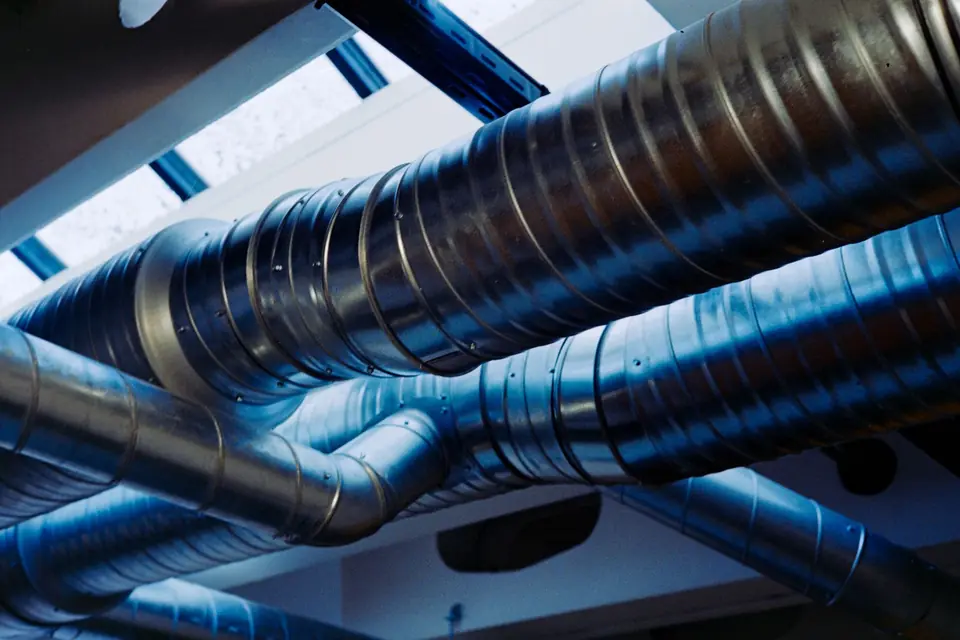
Galvanized spiral pipe in 24 to 28 gauge weighs very little per cubic foot of space it occupies. A 10 ft joint of 12 in diameter spiral is a few dozen pounds, and nesting smaller diameters inside larger ones only goes so far before the bundle needs dunnage to keep the seams from denting. Rectangular duct is worse when it ships assembled: a 48 in section of 24 × 18 in duct is a sheet-metal box enclosing nearly 12 cu ft of air.
That puts most ductwork between 1.5 and 3 PCF, which is class 300 or class 250 on the 13-tier scale. And because a bundle of round pipe dents if anything heavier sits on it, ductwork is nearly always tendered non-stackable. Non-stackable freight is cubed to a 96 in ceiling by every national carrier, so a 48 in bundle is billed at twice its real height. Spiral pipe is sold in standard 10 ft lengths, with longer runs available, so the units are long as well as light, and linear-foot rules come into play at only a handful of bundles.
The equipment side of HVAC is different. Packaged rooftop units, air handlers and split-system condensers are heavier, sit on base rails or skids, and land in class 125 to 175. They still cannot be stacked, and that is usually enough to move them up one or two classes once imputation applies.
Typical HVAC handling units and their density
| Unit | L × W × H (in) | Lbs | Cu ft | PCF | Class | Cubed to 96 in |
|---|---|---|---|---|---|---|
| Spiral duct, 10 ft bundle on skid | 120 × 48 × 48 | 290 | 160.0 | 1.81 | 300 | 0.91 PCF · 400 |
| Rectangular duct, assembled, crated | 96 × 48 × 60 | 330 | 160.0 | 2.06 | 250 | 1.29 PCF · 300 |
| Rectangular duct, knocked down flat | 96 × 48 × 30 | 900 | 80.0 | 11.25 | 92.5 | 3.52 PCF · 250 |
| Fittings and elbows in a gaylord | 48 × 40 × 48 | 190 | 53.3 | 3.56 | 250 | 1.78 PCF · 300 |
| 5-ton packaged rooftop unit on rails | 90 × 52 × 50 | 720 | 135.4 | 5.32 | 175 | 2.77 PCF · 250 |
| Split-system condenser, boxed | 36 × 36 × 40 | 210 | 30.0 | 7.00 | 125 | 2.92 PCF · 250 |
| Air handler section, crated | 96 × 48 × 72 | 1,350 | 192.0 | 7.03 | 125 | 5.27 PCF · 175 |
Weights are representative shipping weights including skid or crate; check the submittal or packing list for your units. The right-hand column is what the carrier's dimensioner sees when the unit is marked do-not-stack or stands over 60 in. Every single line moves at least one class, and the spiral bundle moves from 300 to 400.
Run a spiral duct and fittings load against XPO Item 233
- Safe — tariff cube, density and linear feet stay under the carrier's cube and linear-foot rules.
- Tier 1 — 350 cu ft or more under 3 PCF (XPO, Saia, ABF, Estes): synthetic weight of 6 lbs per tariff cubic foot.
- Re-bill — 750 cu ft or more under 6 PCF, or linear feet at the carrier's rule: book volume LTL or direct partial truckload.
Worked example: four spiral bundles and two gaylords of fittings
A sheet-metal shop ships a job package 780 miles: four 10 ft spiral bundles at 120 × 48 × 48 in and 290 lbs, plus two gaylords of fittings at 48 × 40 × 48 in and 190 lbs. Nothing is stackable. The shop's LTL account is with XPO, whose rules tariff CNWY 199 Item 233 has two cubic capacity tiers.
Gaylords: 48 × 40 × 48 ÷ 1,728 = 53.3 cu ft × 2 = 106.7 cu ft
Actual cube = 746.7 cu ft · Weight = 1,160 + 380 = 1,540 lbs
Density = 1,540 ÷ 746.7 = 2.06 PCF → Sub 3, class 250
On actual cube the shipment sits 3.3 cu ft under the 750 cu ft line. That does not matter, because the units are non-stackable and are cubed to 96 in:
Gaylords: 48 × 40 × 96 ÷ 1,728 = 106.7 cu ft × 2 = 213.3 cu ft
Imputed cube = 1,493.3 cu ft · Imputed density = 1,540 ÷ 1,493.3 = 1.03 PCF → class 300
Synthetic weight at 6 PCF = 1,493.3 × 6 = 8,960 lbs
Both XPO tiers apply: 1,493 cu ft is over 350 cu ft at under 3 PCF and over 750 cu ft at under 6 PCF. Linear feet are also over the line. Bundles run two across, so four bundles take 2 rows × 120 in = 20 LF, and two gaylords side by side add 4 LF, for 24 LF in total against a 12 LF threshold. The carrier would rate 8,960 lbs instead of 1,540.
| Option at 780 miles | Indicative linehaul |
|---|---|
| Class 250 LTL as booked | $611 |
| After Item 233 re-rate and W&I fee | $2,374 |
| Spot volume LTL on 24 LF | $994 |
| Direct partial truckload on 24 LF | $1,133 |
| Dedicated 26 ft box truck | $1,833 |
The $611 class-rated figure was never real. Booked honestly, the choice is between a volume LTL quote at about $994 and a direct partial at about $1,133, both far below the re-rated $2,374. For spiral that has to arrive round enough to join, the extra $139 for a single handling usually wins.
Packaging that changes the bill
The biggest lever in HVAC freight is what you ship flat. Rectangular duct built with Pittsburgh or snap-lock seams can leave the shop as knocked-down halves and be assembled on site. Take 900 lbs of rectangular duct including skids:
| Same 900 lbs of duct | Units | Cu ft | PCF | Class | XPO Item 233 |
|---|---|---|---|---|---|
| Assembled, three crates 96 × 48 × 60 in, non-stackable | 3 | 480.0 | 1.88 | 300 | Both tiers on 768 cu ft imputed |
| Knocked down, one skid 96 × 48 × 30 in, stackable | 1 | 80.0 | 11.25 | 92.5 | Not triggered |
Spiral pipe cannot be knocked down, so the levers there are smaller:
- Nest diameters. Ship 8 in inside 10 in inside 12 in where the order allows, with end caps or cardboard sleeves so seams do not chafe.
- Build bundles to a stackable height. A bundle on a skid with a plywood deck and corner posts can carry a second bundle. Stackable units at or under 60 in are not imputed to 96 in, which halves the billed cube in the example above.
- Keep fittings out of loose cartons. Elbows, tees and reducers belong in a lidded gaylord or a crate with a flat top that can take weight, not in shrink-wrapped piles with pyramid tops.
- Put the real dimensions on the bill of lading. Every bundle, every gaylord, with stackability stated. The BOL dimensional checklist lists what survives a terminal audit.
Equipment and accessorials for jobsite delivery
Ductwork usually delivers to a construction site, and that drives the equipment more than the density does.
- 10 ft bundles and liftgates do not mix. A standard LTL liftgate platform is roughly 4 to 5 ft deep. A 120 in bundle overhangs it by half its length. If the site has a telehandler or forklift, a dry van backed to a ramp or a flatbed unloaded from the side is cleaner. If it has nothing, we tender to a carrier with a straight truck and a crew, or arrange for the mechanical contractor to have equipment on site at the appointment.
- Construction-site access. Most carriers apply a limited-access or construction-site charge. On a partial or dedicated truck we build it into the rate and confirm gate hours and site contact before dispatch.
- Rooftop units. RTUs ship on their own rails and are lifted by crane at the building. They are usually delivered on a flatbed or step deck so the crane can pick straight off the deck; a van delivery means a forklift has to pull the unit out first.
- Weather. Galvanized duct survives rain, but insulated duct liner and boxed controls do not. Open-deck loads with lined duct get tarped.
Which mode Cubic Transport tenders HVAC freight on
We split HVAC tenders by size and fragility:
| Load profile | Imputed cube | Tender |
|---|---|---|
| 1 to 3 stackable skids of fittings or KD duct | Under 350 cu ft | Standard LTL with exact dimensions on the BOL |
| 4 to 8 spiral bundles, dock-to-dock | 750 to 2,600 cu ft | Spot volume LTL priced on linear feet |
| Job package going straight to site, any fragile duct | 750 to 2,600 cu ft | Direct partial truckload, single handling |
| Rooftop units, air handlers | Any | Flatbed or Conestoga partial for crane picks |
| Over 26 to 30 LF | Over 2,600 cu ft | Dedicated 53 ft van or flatbed |
In each case the quote is built from what the carrier's dimensioner will actually measure, so the number on the tender is the number on the invoice, give or take agreed accessorials. Run your own bundles in the engine above, then send the result to rates@cubictransport.com.