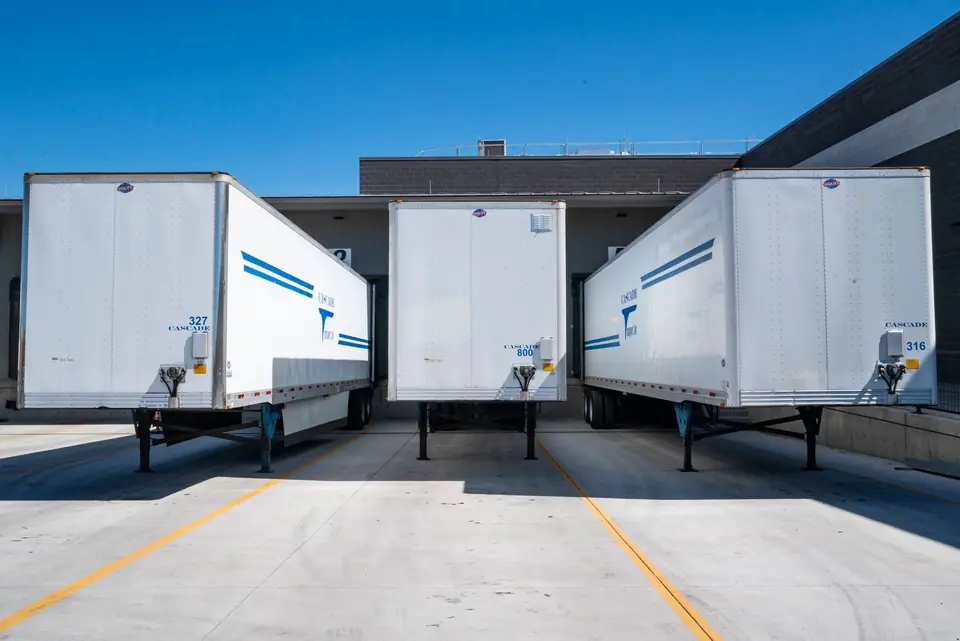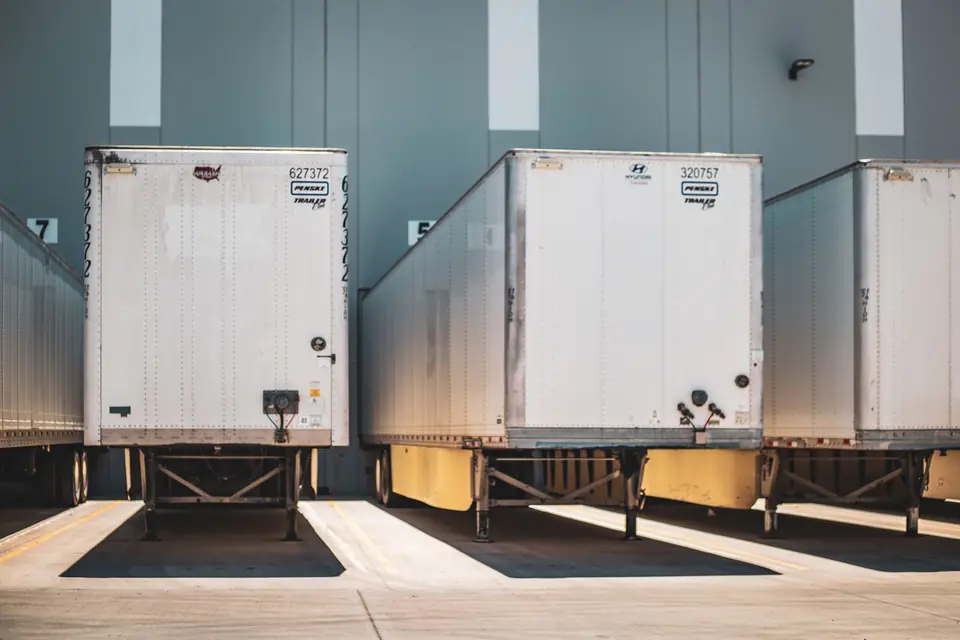
Equipment capacity chart
The chart lists the interior dimensions, cubic capacity and payload our planner and calculators use. They are planning figures: real trailers and containers vary by a few inches with builder, wall type and floor, and the door opening is often lower than the interior height.
| Equipment / mode | Interior (L × W × H) | Usable cu ft | 48×40 pallets | Payload (lbs) |
|---|---|---|---|---|
| Standard LTL tariff slot | Up to 11.5 LF | 50–349 (to 749 if ≥ 6 PCF) | 1–6 | 150–7,500 |
| Spot volume LTL | 12–24 LF | 350–1,650 | 6–12 | 5,000–18,000 |
| Direct partial truckload | 12–36 LF | 750–2,600 | 6–18 | 6,000–28,000 |
| 26' box / straight truck | 26'0" × 96" × 96" | 1,664–1,800 | 12 single / 24 double | 10,000–12,500 |
| 53' dry van | 52'6" × 98.5" × 110" | 3,800–4,054 | 26 single / 52 double | 44,000–45,000 |
| 48' flatbed / Conestoga | 48'0" × 102" × 96–102" | 3,264–3,468 | 24 single | 46,000–48,000 |
| 20' ISO container | 19'4" × 7'8" × 7'10" | 1,172 (33.2 CBM) | 10 GMA | 47,900 |
| 40' ISO container | 39'5" × 7'8" × 7'10" | 2,385 (67.5 CBM) | 20–21 GMA | 58,800 |
| 40' high cube | 39'5" × 7'8" × 8'10" | 2,694 (76.3 CBM) | 21 GMA | 58,450 |
Typical North American interior dimensions; individual trailers and containers vary by manufacturer and wall construction.
Two cautions on reading it. First, a flatbed has no roof, so its "cube" is notional: we quote it at a 96-inch freight height to make it comparable. Second, container payloads are the box's rating; on North American roads the chassis, tractor and the 80,000-lb gross limit usually hold a loaded 40-foot container to well under its rated payload. See the 40-foot high cube loading guide for the road-weight detail.
Floor, cube and weight: the three limits
Every load is limited by whichever runs out first.
- Floor. The number of pallet positions or deck feet. Non-stackable freight is usually limited here: twenty 60-inch non-stackable pallets use 20 positions whatever the roof height.
- Cube. The volume under the roof. Stackable, light freight such as cartons, packaging and foam is limited here. In practice 80 to 90% of nominal cube is usable for palletized or floor-loaded cartons, because pallet footprints and carton sizes never divide the interior exactly.
- Weight. The payload, and on the road the axle and gross limits. Dense freight such as tile, beverages, steel and bagged cement is limited here and leaves floor and height unused.
| Equipment | Nominal cu ft | Payload used for planning | Break-even density |
|---|---|---|---|
| 26' box truck | 1,664 | 10,000 lbs | 6.0 PCF |
| 53' dry van | 3,950 | 44,000 lbs | 11.1 PCF |
| 48' flatbed (at 96") | 3,264 | 46,000 lbs | 14.1 PCF |
| 20' container | 1,172 | 47,900 lbs rated | 40.9 PCF |
| 40' container | 2,385 | 58,800 lbs rated | 24.7 PCF |
| 40' high cube | 2,694 | 58,450 lbs rated | 21.7 PCF |
Break-even density is payload divided by cube. Freight lighter than that fills the space before the weight limit; heavier freight weighs out first. Container figures use the rated payload; road limits lower them sharply for inland moves.
A quick way to use the table: divide your load's weight by its cubic feet. If the result is below the break-even figure for the equipment you are considering, plan the load on floor positions and height, and expect empty payload. If it is above, plan on weight first and expect empty space at the roof. Most of the freight Cubic Transport moves sits between 2 and 10 PCF, well below the van's 11.1, which is why floor and height decide most of our loads.
Pallet floor positions by equipment
These counts come from the same planner that runs below. Straight means the 48-inch side runs along the length; turned means the 40-inch side does; pinwheel alternates the two in pairs.
| Equipment | 48×40 straight | 48×40 turned | 48×40 pinwheel | 48×48 | 1200×800 Euro |
|---|---|---|---|---|---|
| 26' box truck (312 × 96") | 12 | 14 | 14 | 12 | 18 |
| 53' dry van (630 × 98.5") | 26 | 30 | 28 | 26 | 39–40 |
| 48' flatbed (576 × 102") | 24 | 28 | 26 | 24 | 36 |
| 20' container (232 × 92") | 8 | 5 | 10 | 4 | 10 |
| 40' container (473 × 92") | 18 | 11 | 20 | 9 | 24 |
| 40' high cube (473 × 92") | 18 | 11 | 20 | 9 | 24 |
Three things stand out. Containers are only about 92 inches wide, so two 48-inch sides do not fit across: 48×48 pallets go one across, and GMA pallets do best pinwheeled. The turned pattern in a box truck needs 96 inches of clear width, which wall track usually takes away, so plan 12. And double-stacking doubles every count above when the freight is stackable and two tiers clear the door.
Plan your floor
Set the pallet size and equipment in the planner to see straight, turned and pinwheel counts side by side, with the floor drawn to scale.
The planner works in floor positions. For cube and weight, use the engine further down this page, which takes height, weight and stackability and reports the share of a 53-foot van and a 26-foot box your load needs.
Run your load against the equipment
- Safe — tariff cube, density and linear feet stay under the carrier's cube and linear-foot rules.
- Tier 1 — 350 cu ft or more under 3 PCF (XPO, Saia, ABF, Estes): synthetic weight of 6 lbs per tariff cubic foot.
- Re-bill — 750 cu ft or more under 6 PCF, or linear feet at the carrier's rule: book volume LTL or direct partial truckload.
Worked example: twenty non-stackable pallets
Twenty 48×40 pallets of bagged insulation, 60 inches tall, 500 lbs each, marked non-stackable, moving about 1,000 miles. This is the engine preset.
- Cube. 48 × 40 × 60 = 115,200 ÷ 1,728 = 66.67 cu ft × 20 = 1,333.3 cu ft (37.76 CBM).
- Weight and density. 20 × 500 = 10,000 lbs ÷ 1,333.3 = 7.5 PCF, Class 125.
- Floor. Non-stackable, so 20 positions.
| Equipment | Fits 20? | Floor used | Cube used | Weight used |
|---|---|---|---|---|
| 26' box truck | No (12 max) | — | — | — |
| 53' dry van | Yes, straight | 40 of 52.5 ft (76%) | 34% of 3,950 | 23% of 44,000 |
| 48' flatbed | Yes, straight (24 max) | 40 of 48 ft (83%) | Open deck | 22% of 46,000 |
| 20' container | No (10 max) | — | — | — |
| 40' container | Yes, pinwheeled | 20 of 20 positions | 56% of 2,385 | 17% of 58,800 |
| 40' high cube | Yes, pinwheeled | 20 of 20 positions | 49% of 2,694 | 17% of 58,450 |
The load is floor-limited everywhere: it uses a third of a 53-foot van's cube but three quarters of its floor. In LTL it would be cubed at 96 inches, 2,133.3 cu ft at 4.69 PCF, and 40 linear feet is far past the 12-foot rule. Domestically, a partial on 40 of 52.5 feet runs about $2,013 for 1,000 miles in our model against $2,450 for the whole van; at 76% of the floor, the exclusive trailer for $437 more is often the better buy. If the bags could be packed to stack two-high at 48 inches each, the same product would need 10 positions instead of 20.
Cubic feet and CBM for each unit
Ocean and international shippers quote cubic metres; North American carriers quote cubic feet. One cubic metre is 35.3147 cubic feet, and one cubic foot is 0.0283168 cubic metres.
| Equipment | Cubic feet | CBM |
|---|---|---|
| 26' box truck | 1,664 | 47.1 |
| 53' dry van | 3,950 | 111.9 |
| 48' flatbed (at 96") | 3,264 | 92.4 |
| 20' container | 1,172 | 33.2 |
| 40' container | 2,385 | 67.5 |
| 40' high cube | 2,694 | 76.3 |
For conversions on your own figures, use the CBM to cubic feet calculator.
Which equipment for which load
Capacity tells you what fits; the mode decides what it costs. A short guide that links the two:
| Your load | Equipment that fits | Usual mode |
|---|---|---|
| Up to 6 GMA positions, under 12 linear feet | Any | Class-rated LTL, unless light and non-stackable |
| 6–12 positions, under 10,000 lbs | 26' box truck or part of a 53' van | Box truck, volume LTL or partial |
| 12–18 positions | Part of a 53' van or 48' flatbed | Direct partial or shared truckload |
| 18–26 positions, or 30 turned | 53' van | 53' truckload |
| Side or crane loading, tall machinery | Flatbed, step deck, Conestoga | Open-deck partial or truckload |
| Import or export | 20', 40' or 40' high cube | Ocean container, then drayage or transload |
The counts assume single-tier GMA pallets. Stackable freight halves the floor positions in every row; oversized crates and 48×48 pallets change the container rows most. Run your own footprint through the planner above before choosing.
Common capacity mistakes
- Planning on interior height instead of door height. A van with 110 inches inside may have a door a few inches lower; a box truck with a roll-up door may clear only about 90 inches.
- Ignoring overhang. A 48×40 pallet with product hanging 2 inches over each side is a 52×44 footprint. Two across at 44 inches is 88 inches, which still fits a container, but two 52-inch sides need 104 inches and fit nowhere.
- Counting pallets in containers like trailers. Containers are about 6 inches narrower than a van. 48×48 pallets go one across.
- Assuming rated container payload on the road. Inland weight is set by the chassis and gross limits, not the box rating.
- Double-stacking non-stackable freight on paper. If the top can't take weight, the count is the floor count.
For linear feet on your own load, the linear foot calculator uses the same footprint rules.