Dense freight with tall-skid problems
Low-voltage switchgear and switchboards ship in sections, typically 30 to 40 in wide, 60 to 80 in deep and 90 to 95 in tall, at 1,500 to 3,500 lbs each. Motor control centers ship in narrower vertical sections. Free-standing control enclosures are lighter steel cabinets around 84 in tall. Crated machines and dry-type transformers are compact and heavy. On density alone most of this freight is class 65 to 92.5, well clear of cube rules.
The trouble is elsewhere:
- Height. A 92 in section will not clear the roughly 90 in rear door of a typical 26 ft box truck, leaves little room in a 53 ft van door, and cannot be laid down. It rides upright or not at all.
- Top-heavy centers of gravity. Bus bars and breakers sit high in the section. A sudden stop on a pallet jack or a forklift lifting from the wrong side can tip a section that weighs more than a car's engine block.
- Linear feet. Sections are deep, so even dense loads take floor space fast. Three sections and a few enclosures can take 18 LF.
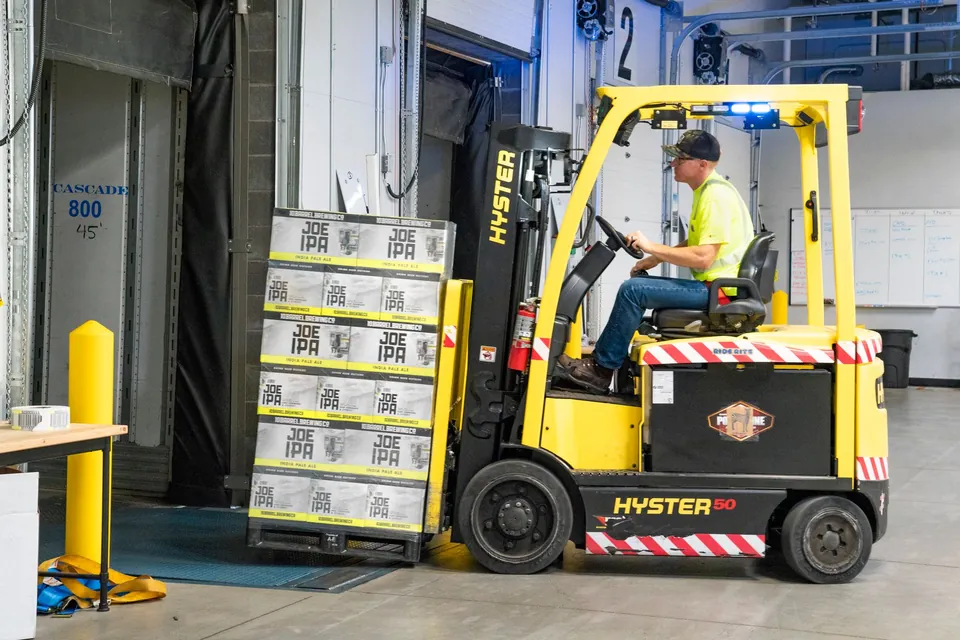
- Delivery. Substations, plant floors and construction sites often have no dock. Switchgear is commonly unloaded by crane or by a forklift from the side of an open deck.
That pushes this freight toward open-deck and side-loading equipment, and away from terminal cross-docks where every additional lift is another chance to tip a section.
Typical electrical and machinery handling units
| Unit | L × W × H (in) | Lbs | Cu ft | PCF | Class | Cubed to 96 in |
|---|---|---|---|---|---|---|
| Low-voltage switchgear section on skid | 72 × 40 × 92 | 2,400 | 153.3 | 15.65 | 70 | 15.00 PCF · 70 |
| Free-standing control enclosure | 72 × 24 × 84 | 450 | 84.0 | 5.36 | 175 | 4.69 PCF · 175 |
| Motor control center section | 24 × 22 × 90 | 650 | 27.5 | 23.64 | 65 | 22.16 PCF · 70 |
| Crated machine | 96 × 60 × 70 | 3,800 | 233.3 | 16.29 | 70 | 11.88 PCF · 92.5 |
| Dry-type transformer on skid | 60 × 40 × 72 | 2,600 | 100.0 | 26.00 | 65 | 19.50 PCF · 70 |
Weights are representative; use the manufacturer's shipping split drawing for exact figures. The control enclosure is the light member of the group, at class 175, and on a mixed load it is the unit that pulls overall density down. Note also the MCC line: at 23.64 PCF it sits in the class 65 band, but imputation to 96 in moves it just under 22.5 PCF and into class 70. Every unit here is either over 60 in or not safely stackable, so the imputation applies to all of them.
Run switchgear and enclosures against ABF Freight
- Safe — tariff cube, density and linear feet stay under the carrier's cube and linear-foot rules.
- Tier 1 — 350 cu ft or more under 3 PCF (XPO, Saia, ABF, Estes): synthetic weight of 6 lbs per tariff cubic foot.
- Re-bill — 750 cu ft or more under 6 PCF, or linear feet at the carrier's rule: book volume LTL or direct partial truckload.
Worked example: three switchgear sections and four enclosures
A panel shop ships 700 miles to a plant expansion: three switchgear sections at 72 × 40 × 92 in and 2,400 lbs each, and four control enclosures at 72 × 24 × 84 in and 450 lbs each. Nothing is stackable. The shop's LTL account is with ABF Freight (ABF 111 Item 616 / 611).
Enclosures: 72 × 24 × 84 ÷ 1,728 = 84.0 cu ft × 4 = 336.0 cu ft
Actual cube = 796.0 cu ft · Weight = 7,200 + 1,800 = 9,000 lbs
Density = 9,000 ÷ 796.0 = 11.31 PCF → Sub 7, class 92.5
Imputed density = 9,000 ÷ 864.0 = 10.42 PCF → still class 92.5
Linear feet = 2 rows × 72 in (sections two across) + 1 row × 72 in (enclosures four across) = 216 in ÷ 12 = 18.0 LF
No cubic capacity rule applies: the load is over 750 imputed cu ft but well above 6 PCF. What it does cross is linear feet. At 18 LF it is past the 12 LF line where carriers move freight to capacity-load or volume treatment, and the engine prices that path:
| Option at 700 miles | Indicative linehaul |
|---|---|
| Class 92.5 LTL as booked | $1,240 |
| After linear-foot / capacity re-rate | $2,244 |
| Spot volume LTL on 18 LF | $755 |
| Direct partial truckload on 18 LF | $870 |
| Dedicated 53 ft truckload | $1,715 |
The box truck is left off the table on purpose: at 9,000 lbs the load is close to a 26 ft box truck's payload, and 92 in sections will not clear its door. The direct partial at about $870, on a Conestoga or an air-ride van at dock height, is $370 under the class-rated LTL bill and less than half the re-rated one, and the sections are lifted twice instead of six times.
The class itself is close to a boundary. At 11.31 PCF the load is 552 lbs short of 12.0 PCF and class 85. That is not worth chasing with extra weight, but it is a reminder to weigh every section on a certified scale and write the real figure: a shipping split estimated light by a few hundred pounds per section can cross a tier line the other way and turn into a weight and inspection correction.
Loading and securement guidance
- Lift from the base, by the marked points. Switchgear has lifting angles or eyes at the top for cranes and a base sill for forklifts. Use the long tines that reach all the way through, and never lift from the side the manufacturer marks against.
- Keep sections upright and braced. Strap each section to the trailer wall or deck at two heights, with load bars or blocking at the base so it cannot walk.
- Tarp or enclose. Switchgear must stay dry. On a flatbed it rides under a full tarp with edge protection; a Conestoga gives the same side access with a rolling cover.
- Specify air-ride for controls. Control panels with PLCs, drives and HMIs ride better on air-ride vans or air-ride Conestogas.
- Put the shipping split on the BOL. List each section with its exact dimensions, weight and orientation. The BOL checklist covers the format.
Equipment choices for tall, heavy units
| Equipment | Height limit for freight | Loading | Use it for |
|---|---|---|---|
| 53 ft dry van, air-ride | Door roughly 108–110 in; interior about 110 in | Dock forklift at both ends | Sections under about 100 in, dock-to-dock |
| Conestoga | About 96–102 in under the tarp kit, depending on deck | Side or top, forklift or crane | Switchgear to sites without docks, weather protected |
| 48 ft flatbed | About 8 ft 6 in on a 5 ft deck within 13 ft 6 in legal height | Side forklift or crane | Crated machines, transformers, tarped switchgear |
| Step deck | About 10 ft on the lower deck | Side or crane | Tall machines and enclosures over 8 ft 6 in |
| 26 ft box truck | Door about 90 in, payload around 10,000 lbs | Liftgate or dock | Single control panels under the door height |
At delivery, rigging contractors often set switchgear directly into its room. Tell us the unloading method at tender so the carrier knows whether to expect a crane, a forklift from the side, or a dock.
Which mode Cubic Transport tenders this freight on
Single enclosures and small crated machines go standard LTL with exact dimensions. Switchgear line-ups and multi-unit machinery orders go on a Conestoga or flatbed partial where the site has no dock, or a direct partial in an air-ride van where it does. Loads past about 26 LF or 20,000 lbs move as a dedicated truckload. We do not provide rigging; we coordinate the carrier's arrival with your rigger.